0800 699 353
 Parts Finder


Table of Contents
There's a quiet problem building inside millions of diesel tanks right now - on boats, on farms, in generators, and in fleet vehicles sitting between jobs. Most owners won't know anything's wrong until their engine dies at the worst possible moment. Here's everything you need to know.
Most people who've dealt with the diesel bug remember exactly where they were when it got them. It's that kind of problem, dramatic, inconvenient, and almost always avoidable in hindsight.
It might be an engine cutting out mid-channel with a cross-tide running. A tractor that won't start on the first morning of harvest. A standby generator that turns over but won't fire during a power cut. The circumstances are different every time. The cause is usually the same.
Diesel bug, the contamination of diesel fuel by microbial growth, is now responsible for the majority of diesel engine failures. And as the composition of pump diesel has changed in recent years, it's becoming more common, not less. If you rely on diesel in any serious way, understanding what's happening inside your tank is no longer optional.
What Diesel Bug Microbial Contamination Actually Is
The term "diesel bug" gets used loosely, but it refers to something very specific: the growth of microorganisms, bacteria, mould, yeast, and the sticky biofilm they produce inside a diesel fuel tank. It's not a single organism, and it's not an algae, despite what you might have heard. Algae need light for photosynthesis, and there's no light inside a diesel tank. What you're dealing with is a colony of bacteria and fungi, often numbering in the millions, living and feeding at the point where water meets fuel.
That last part matters. The diesel bug doesn't live in the fuel itself; it lives at the interface between the water layer that accumulates at the bottom of the tank and the fuel sitting above it. Remove the water, and you remove the habitat. Leave it, and the colony grows. A single bacterial cell can double every 20 to 30 minutes. One cell becomes two million in roughly seven hours. In a tank that hasn't been opened or treated in months, the maths become genuinely alarming.
What the colony produces is visible: a dark brown or black sludge, sometimes described as looking like coffee grounds, sometimes as a thick slime. It coats tank walls, collects in the lowest points of fuel lines, and clogs filters. When it breaks loose, which it does, particularly when a vessel is moving or a vehicle is being driven, it travels through your fuel system. Filters block. Injectors foul. Engines fail.
Why It's Getting Worse Right Now
Twenty years ago, the diesel bug was a real but manageable nuisance. Over the past decade, it has become significantly more prevalent, and the reason is straightforward.
Modern diesel sold at forecourts and fuel depots contains up to 7% FAME (Fatty Acid Methyl Ester) biodiesel, blended in to meet emissions targets and improve air quality. FAME is derived from vegetable oils and animal fats, and it does its environmental job well. The problem is that it's hygroscopic; it actively attracts and holds water from the surrounding atmosphere.
Standard mineral diesel and water don't mix well. FAME, by contrast, draws moisture in. Through a sealed tank breather. From humid air. Through micro-condensation that forms on tank walls as temperatures rise and fall through the day. The higher the FAME content in the fuel, the more water it will pull in over time, and the more ideal the conditions become for microbial growth.
This is the root cause of why the diesel bug seems worse than it used to be. The fuel has changed. Boat owners who kept their tanks clean for decades are suddenly dealing with contamination problems they've never had before. Farmers who've run the same fuel storage setup for years are finding degraded fuel at the start of the season. It isn't bad luck. It's chemistry, and it affects everyone who stores diesel for any length of time.
How Water Gets Into Your Tank
Water in fuel is the core of the problem. Understanding the routes it takes helps you understand where your risk lies.
The most persistent source is condensation. A fuel tank is not a sealed environment in any meaningful sense it has vents and filler caps that allow the air inside to exchange with the outside atmosphere. As ambient temperature drops overnight, the air in the empty headspace above the fuel cools, and moisture condenses on the cool metal walls. It drips down and collects at the bottom, contaminating fuel tanks with water. This happens whether the tank is on a boat moored in a marina, a farm diesel tank sitting in a field, or a generator tucked away in an outbuilding. Even small amounts of daily condensation add up to a significant water layer over a season, and a lower fuel level leaves more headspace for that cycle to repeat.
Atmospheric absorption adds to this in fuels with significant FAME content. Unlike condensation, which requires a temperature differential, hygroscopic absorption happens continuously. The biodiesel fraction in your fuel is continually drawing moisture.
Physical ingress is the third route for rainwater that seeps through a worn filler cap seal, a damaged vent, or contaminated fuel taken on from a supplier whose stock hasn't turned over quickly enough. This last point is worth noting, particularly for marine diesel: fuel taken from a fuel barge in a quiet marina may have been sitting in that barge's own storage tanks for weeks or months before you put it in yours.
Once free water is present at the bottom of the tank, even in quantities invisible to the naked eye, the conditions for diesel bug are met. Even a small amount of water droplets at the bottom of fuel storage tanks can trigger diesel bug growth because they create the conditions microbes need. From that point, contamination is a matter of time, not chance, and microbial contamination in fuel tanks can quickly damage systems.
Owners should drain free water and sediment from the tank via a drain or, where fitted, a low-point valve.
A fuel sample taken from the bottom should be used to test water content and microbial contamination, so test results can guide early action.
The Warning Signs to Watch For
Part of what makes diesel bug so damaging is how gradually it develops and how easily the early signs are misread. Common diesel bug symptoms can be subtle at first: a filter that needs changing slightly sooner than expected, an engine that takes a couple of extra turns to start on a cold morning, or a faint smell from the tank that you put down to old fuel. These are easy to overlook.
By the time diesel bug announces itself decisively, an engine that won't run, a filter so blocked it needs replacing mid-trip, the contamination is already well advanced.
The signs that your diesel may be contaminated include: blocked fuel filters that repeatedly show dark, sludgy residue; fuel that looks cloudy, discoloured, or darker than it should; reduced power, poor engine performance, and increased fuel consumption; a sulphurous or eggy smell that can resemble rotten eggs, or the varnish-like smell that comes from oxidised fuel; engines that hunt or run roughly at idle; black smoke from the exhaust under load; and, in more advanced cases, the brown sludge residue left in the tank, or visible corrosion on metal tank fittings or the tank walls themselves.
If you draw a small fuel sample from the bottom of a tank you suspect is affected, hold the container up to the light. Healthy diesel is clear or slightly amber. If the sample is dark, murky, or shows visible sludge or suspended particles, it supports a diagnosis of fuel contamination.
Diesel bug doesn't discriminate between engine types, fuel volumes, or how well-maintained your equipment is. What it does discriminate on is the use pattern and storage environment, and that makes some situations significantly higher risk than others. The table below sets out who's most vulnerable, why, and what the appropriate response is.
| Who | Why the Risk Is Higher | What to Do |
| Boat and marine diesel users | Marine diesel tanks sit unused for weeks or months, creating ideal conditions for condensation. Fuel barges often have slow stock turnover, meaning contamination may arrive with the delivery | Treat at every fill; double dose for winter lay-up; fill tank to reduce air space |
| Farm diesel tank owners | Large-volume storage with slow seasonal turnover. Outdoor tanks experience significant daily temperature swings, driving persistent condensation | Treat the storage tank level so every draw is protected; inspect the tank base at the start of each season |
| Standby generator owners | Fuel sits undisturbed for months or years. No regular circulation to flag early filter blockages. Failure is only discovered when the generator is critically needed | Double or triple dose; date-stamp the treatment; replace fuel after 24 months regardless of appearance |
| leet and transport operators | High fuel volume and multiple vehicles drawing from shared storage tanks. A contaminated bowser puts the entire fleet at risk simultaneously | Treat the storage tank, not just individual vehicles; monitor filter replacement frequency as an early warning indicator |
| Anyone using modern biodiesel blends | All pump diesel now contains FAME biodiesel, which is hygroscopic. Every diesel user is affected to some degree. The question is how much water has accumulated and how long it's been there | Regular preventative treatment is now standard practice, not an optional extra |
What Happens When You Leave It Alone
The cascade of damage that follows untreated contaminated diesel is expensive and, in some situations, dangerous; by the time these effects appear, significant damage may already be affecting the tank and fuel system components, especially with heavily contaminated fuel or large amounts of sludge.
Biofilm that forms on tank and pipe walls doesn't stay put. Physical agitation, a boat moving on its mooring, or a vehicle going over rough ground shakes it loose. It travels through the fuel lines and is filtered. When blocked fuel filters can't catch it all, or a fouled primary filter or filter element is bypassed because the engine is struggling to draw fuel through a blocked element, debris continues downstream toward fuel injectors. Modern common-rail diesel injectors work to tolerances of just a few microns. It doesn't take much contamination to cause misfires, power loss, and ultimately injector failure. A single injector replacement can run to several hundred dollars; a full set, considerably more.
Beyond the bugs themselves, the water they depend on causes direct mechanical harm. Water in fuel reduces its lubricity, the ability of the fuel to lubricate the precision components it flows through. Fuel pumps and injectors wear faster. At the point of combustion, emulsified water (water held in suspension in the fuel rather than settling at the bottom) causes gums, waxes, and resins to separate and deposit on injectors and combustion chambers, while microbes use hydrocarbons as a food source and produce biomass and other byproducts that worsen contamination.
The biofilm also secretes acid. Against the metal walls of a steel fuel tank, that acid corrodes from the inside out, eventually causing pitting, leaks, and in severe cases, complete tank failure. Bacteria, yeast, other fungi, and fungal spores can all be involved, with Hormoconis resinae being especially problematic because it adheres to tank surfaces and accelerates corrosion.
None of this is quick or catastrophic in the early stages. That's the deception. The diesel bug gives you plenty of warning signs before it kills your engine. The problem is that those warnings are easy to rationalise away until they're not.
How to Fix the Diesel Bug and Prevent It from Coming Back
The cleaning process for a contaminated diesel tank is a significant job, and fuel polishing is one professional method used to remove water, sludge, and microbial contamination through filtration and circulation. It involves pumping out the fuel, physically cleaning the tank interior, replacing fuel filters, and polishing or replacing the fuel itself; the tank may also need to be pumped out and drained at its low point before cleaning starts. Professional tank-cleaning services do excellent work, but the cost is real.
The better approach, by a considerable margin, is to prevent the problem from reaching that point and, if contamination is already present, to treat the fuel rather than replace it. To prevent diesel bug or treat diesel bug early, owners should test fuel quality before contamination becomes severe.
The key to fixing the diesel bug is not simply killing the microorganisms, but removing the water they live in. A good diesel fuel treatment works not by poisoning the bugs, but by dispersing the water layer at the bottom of the tank, absorbing it into the fuel and allowing it to pass harmlessly through the combustion cycle. Without that water interface, the microbial colony cannot sustain itself.
This also addresses the damage water causes, independent of wear on pumps and injectors, combustion problems caused by emulsified water, and the degradation of fuel quality over time.
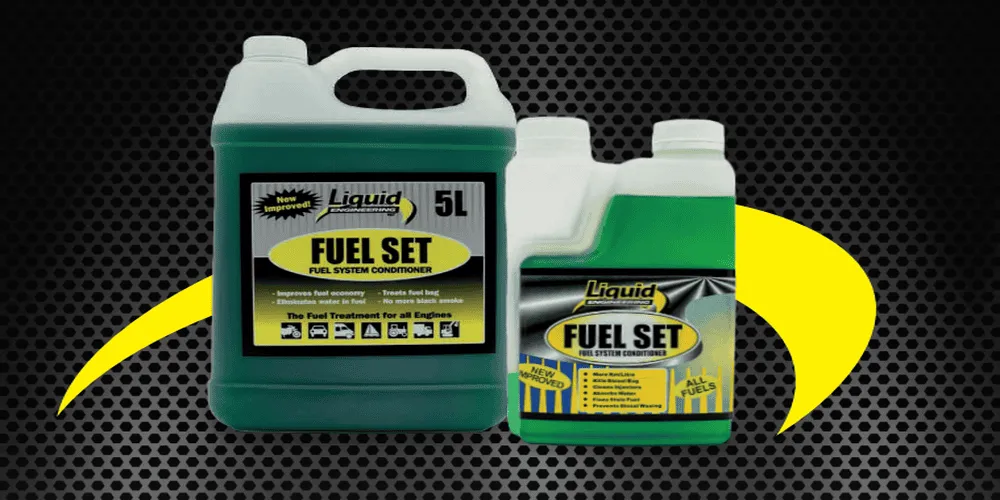
Liquid Engineering Fuel Set is the diesel fuel treatment we stock and recommend for exactly this. It eliminates water from the fuel system, reconditions stale or aged fuel, improves combustion efficiency, and does so at a dose rate of just 1 litre to 4,000 litres of fuel, one of the most economical treatments available. It's compatible with diesel, petrol, two-stroke, and heating oil, has no harmful effect on engine components, and has been in use since 1991 without a single warranty claim. Regular test checks help confirm contamination is present and whether treatment is working. For cleaning a diesel tank without a full professional intervention, treating the fuel at the first signs of contamination, replacing any blocked filters, and ensuring the tank is properly sealed can arrest the problem before it escalates.
The Case for Regular Diesel Fuel Treatment
Whether you're dealing with marine diesel in a yacht's tank, diesel in a farm storage vessel, or fuel in a generator that might sit unused for long periods, the principle is the same: preventative treatment costs a fraction of reactive repair, especially when contamination risk builds in storage tanks.
A quality diesel fuel treatment added at each fill or at the start of each season for equipment that sits over winter does several things simultaneously. It addresses water in fuel by dispersing it safely, helping manage water content. It slows the oxidation of the fuel itself, extending its usable life and preventing the degradation that turns diesel stale and varnish-smelling in storage. It provides additional lubrication to fuel system components, helping protect both traditional fuels and modern blended diesel. And it ensures that when you next go to use the engine, whether that's a week later or after a winter lay-up, the fuel in the tank is still in serviceable condition.
For farm diesel tanks in particular, treating at the storage tank level is the most efficient approach. This is especially useful where tanks sit for long periods, and contamination can build up unnoticed. Every machine that draws from that tank benefits automatically, without needing individual treatment.
The full Liquid Engineering range available through Proline Industrial includes Fuel Set in 200ml, 1L, 5L, and 20L sizes, suitable whether you're treating a single boat tank or a large commercial storage vessel. Free delivery applies to orders over $50, and the Farmlands Card is accepted online for rural customers.
A Problem Worth Taking Seriously
The diesel bug is not going away. As biodiesel blending rates continue to rise in line with environmental legislation, the conditions that encourage water ingress and microbial growth will only become more common in standard pump diesel. Boat owners, farmers, fleet managers, and anyone else who stores diesel for any serious purpose is managing a contamination risk, whether they know it or not.
The practical response isn't complicated. Inspect your tank periodically. Know the warning signs. Buy fuel from suppliers with good stock turnover. Keep your filler cap seal in good condition. And treat your fuel regularly with a quality diesel fuel treatment.
The engines and equipment that keep your business or your leisure running deserve clean fuel.