0800 699 353
 Parts Finder


Table of Contents
.webp)
A generator burns fuel to drive an alternator, producing electricity for as long as the tank holds out. Inverter generators add electronics that smooth the output for sensitive equipment.
A portable power station, often called a battery-powered generator, has no engine. It stores energy in a lithium battery and delivers 230 V AC output through its outlets, then you recharge it from the grid using AC charging.
Two numbers explain the difference. Watt hours (Wh) show the battery's capacity, or how much energy it can store, like the size of a fuel tank. Watts (W) show how much power the unit delivers at once. Continuous watts are what it supplies steadily; surge watts are the short bursts it gives while a motor starts.
Whether a charge holds enough energy for a full day depends on your load. Divide stored energy by load for a rough runtime: 2,304 Wh feeding a steady 1,000 W is about 2.3 hours in theory, and less in practice.
Generator vs Portable Power Station: Side by Side
| Factor | Petrol generator | Portable power station |
| Upfront cost | Usually lower | Usually higher. Price on request |
| Running cost | Fuel, oil and servicing | Mains electricity to recharge |
| Noise | Engine noise, even when silenced | GTi20000G5 stated below 30 dB |
| Emissions and indoor use | Carbon monoxide exhaust. Outdoors only | No exhaust fumes |
| Runtime | As long as you refuel | Limited by battery (2.1 to 2.3 kWh per unit) |
| Refuel vs recharge | Minutes | About 2 to 2.2 hours from mains |
| Maintenance | Oil, plugs, filters, fuel system | No engine to service |
| Weight and portability | Heavy, plus fuel | 20 to 24 kg, compact |
| Start up | Pull or electric start, warm up | Instant on |
Where Petrol Generators Still Excel
A generator is the better choice for:
- Long days with no charging access, where a battery will eventually run flat.
- Heavy continuous loads such as large compressors, site heaters and site sheds running for hours.
- Remote rural, forestry and roading sites far from any grid.
- A working week off-grid, where fuel is easier to bring in than a power point.
Look at the GT Power GT4000ESI (4,000 W / 5 kVA) for lighter tool work, or the GT Power GT8000ESI (8,000 W / 10 kVA, with electric start and two-wire auto start) for bigger loads. Browse the full inverter generator range, or choose from conventional generators.
Carbon monoxide warning: Petrol generators produce carbon monoxide and must only run outdoors, never in a building, garage, container or enclosed space. Follow the placement guidance in the operator's manual.
Where Portable Power Stations Excel
Battery power shines where a generator causes problems:
- Indoor fit-outs and occupied buildings such as schools, hospitals, offices and apartments.
- Early starts on residential streets, including urban infill in Auckland and Wellington. Construction noise is assessed under NZS 6803:1999, and removing the engine removes a major noise source.
- Confined spaces, service vans, events and emergency response, where a fume-free unit you can carry a short distance helps.
Proline states that the GT Power GTi20000G5 portable power station has been independently tested under continuous 100 A welding arc for 30 minutes, equivalent to approximately 25 × 2.5 mm GP electrodes. For crews who move around a building, the Instagrid One portable battery-powered unit weighs 20 kg and is designed to be lifted with one hand, making portability a real strength.
Will a Battery Unit Run Your Tools?
Yes, for most site tools, within limits. Motor-driven tools draw a startup surge well above their running rating. With up to 20,000 W surge on the GTi20000G5 and 18,000 W peak on the Instagrid One, starting power tools such as a circular saw, core drill, angle grinder, stick welder or submersible pump is far less of an obstacle than it was with older battery units.
The limit to plan around is sustained output. The GTi20000G5 delivers 3,600 W of continuous power, and the Instagrid One delivers 230 V / 16 A output. Step one is to check the compliance plate on each tool for its rated input in watts. Step two is to add up everything running at once, including site lights, and match the total to the unit's rating. The sweet spot is a unit whose continuous output comfortably covers your heaviest tool. Running one heavy tool at a time gets the most from a jobsite power station.
The Real Cost Over Time
How long until a battery unit pays for itself? In any comparison between a portable power station and a generator, the generator is usually cheaper to purchase. The battery fights back on running costs. A generator needs fuel, oil, spark plugs, filters and fuel system care, and hard starts on cold mornings cost time. A battery unit has no engine to service and recharges from mains electricity.
To estimate payback for your business, add up a year of fuel, servicing and repair costs on the generator you would replace, then compare that with the price difference. Proline does not list power station prices online, so request a quote for the current price and availability.
Charging, Ports and What to Confirm Before You Buy
Check the specifications against what you expect. The GTi20000G5 lists fast charging from AC mains in about 2.2 hours and two 230 V AC output ports, with no USB or USB-C ports listed. The Instagrid One recharges in 2 hours and allows expansion to three linked units.
Neither product page lists solar panels, car charging, a waterproof rating, or cycle life, so do not assume they do. Keep units out of the rain and ask the Proline support team for any details you need.
The Modern Upgrade: GT Power GTi20000G5 and Instagrid One
If you are comparing battery generator options in NZ, these two are worth shortlisting for everyday site power.
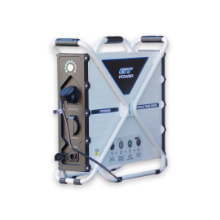
GT Power GTi20000G5. The 20,000 W in the name is surge; continuous output is 3,600 W from a 2,304 Wh 5th-generation NCA lithium battery. Its battery management system protects against overtemperature, overcurrent, short circuit, and overvoltage, and a reinforced, welded steel chassis protects it on-site. It weighs 24 kg. Best for welding and heavy outdoor work. View the GT Power GTi20000G5.
Instagrid One. It delivers 230 V / 16 A output with 18,000 W peak from 2.1 kWh of storage, rising to 6.3 kWh when three units are linked. It is made in Germany, carries a 4-year warranty and is built for off-grid use. Best for plumbers, electricians, and fit-out crews moving between floors. View the Instagrid One.
Which Should You Choose?
- Indoor fit-out or occupied building: battery unit.
- Residential build in town: battery unit for the tools.
- Civil, roading or remote site: generator.
- Service van: battery unit.
- Welding: power station for repairs and mobile work, generator for all-day fabrication.
Many crews run both: a battery unit on the tools and a generator for long days and heavy loads. Compare the full portable power station range or all generators, and talk to the Proline team about your tools and site.