0800 699 353
 Parts Finder


Table of Contents
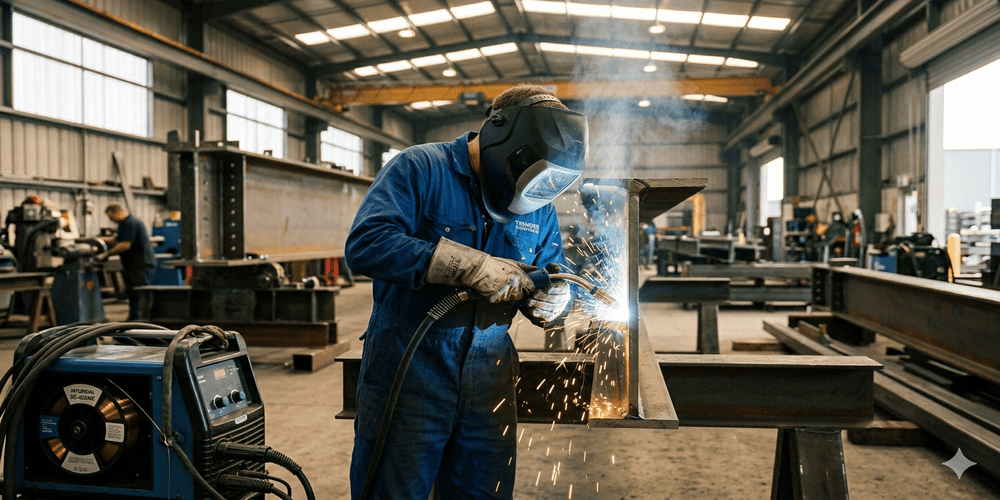
Welding fume is a confirmed human carcinogen. The International Agency for Research on Cancer classified it as Group 1 in 2017, and WorkSafe New Zealand continues to update its guidance on controlling worker exposure to welding fumes in industrial environments. Despite this, many workshops across Aotearoa still treat fume management as an afterthought, relying on open doors and natural ventilation to do the heavy lifting.
Trinder Group is not one of them. Under the leadership of Managing Director Kerry Hill, this Nelson-based engineering firm has positioned itself at the forefront of workplace health and safety, investing seriously in at-source welding extraction to protect its workforce. Their story is worth sharing, because it illustrates exactly what responsible industrial practice looks like in the real world, and why the choice of industrial fume extractor matters far more than most businesses realise.
The Invisible Threat Inside Every Welding Workshop
Welding fumes are not simply smoke. They are a complex mixture of metallic oxides, silicates, and fluorides generated when base materials, coatings, and filler metals are heated above their melting points. Particles at the ultrafine end of the spectrum, those under 0.1 microns in diameter, penetrate deep into the alveolar region of the lungs and are not expelled through normal respiratory function.
Short-term effects include irritation of the nose, throat, and eyes. Long-term, repeated exposure is associated with chronic obstructive pulmonary disease, lung cancer, neurological damage from manganese, and in some cases, metal fume fever. The risk is not theoretical. It is the daily reality for welders who work in environments without adequate extraction and filtration.
For Trinder Group's welding supervisor Wayne Martin, this is personal. Years of working in environments with limited fume control left him with respiratory issues that continue to affect him today. That lived experience is precisely why he has become one of the most vocal advocates for upgrading welding extraction systems across the business. When someone with that background tells you the new equipment makes a visible difference, it carries real weight.
Trinder Group's Approach to Welding Extraction
Kerry Hill frames Trinder Group's approach to welding extraction in straightforward terms: "Welding fume isn't good for you, and so we're looking for every practical way to reduce the fume."
That principle has driven a series of equipment upgrades focused on at-source capture, the most effective method of controlling welding fumes because it intercepts contaminated air before it has any opportunity to disperse into the breathing zone of the welder or surrounding workers. Rather than relying on general ventilation to dilute fumes across a large workshop space, at-source systems draw contaminated air directly away from the arc point, filter it, and return clean air to the environment.
This approach aligns with WorkSafe NZ's hierarchy of controls, which prioritises elimination and engineering controls above administrative measures and personal protective equipment. At-source fume extraction sits at the engineering control tier, making it one of the most defensible and effective strategies available to workshop operators.
Trinder Group has integrated purpose-built welding fume extraction systems into their welding operations, selecting equipment that captures fumes directly at the torch rather than relying on ambient extraction alone. The results have been immediately observable.
What At-Source Industrial Fume Extraction Actually Does
Understanding the mechanics helps demystify the technology. A quality industrial fume extractor operates on the same fundamental principle as a high-powered vacuum, but engineered for the specific demands of welding environments rather than general industrial cleaning.
Inside the unit, a motor drives a turbine that generates significant negative static pressure. This pressure differential draws contaminated air through a suction point positioned close to the welding arc. That air travels through internal filtration stages, typically including a pre-filter to capture larger particles and a high-efficiency main filter designed to capture ultrafine metallic particulates. Cleaned air is then returned to the workshop.
At-source extraction torches take this a step further. A fume extraction MIG torch functions identically to a standard MIG torch in terms of welding performance, using the same consumables, wire, and cable. The difference is a built-in housing and a front-end shroud that captures fumes as they are generated, before they can rise toward the welder's face. A secondary hose running alongside the torch cable carries the captured fumes back to the extractor unit.
The critical calibration point is vacuum pressure. Too low, and fumes escape capture. Too high, and shielding gas is drawn away from the weld puddle, risking porosity. Finding the right balance is straightforward once operators understand the adjustment range, and modern extraction units make this easier with adjustable flow controls.
The filter tray tells the story plainly. Senior tradesman Damian at Trinder Group describes the revelation of opening the tray after a relatively short period of use: "It's surprising how much it picks up when you empty the tray." That accumulated particulate is material that, without extraction, would otherwise have been breathed in by the people working alongside him.
Beyond Compliance: The Moral Case for Better Industrial Air Quality
New Zealand's Health and Safety at Work Act 2015 sets a clear legal obligation to manage workplace hazards so far as is reasonably practicable. For most industrial environments, investing in modern welding extraction equipment is entirely within that definition of reasonable practicability, particularly given how significantly the technology has advanced and how competitively it is now priced.
Kerry Hill does not stop at the legal argument, however. "There's a moral obligation as well just to be doing the right thing," he says. That statement reflects a broader shift in how forward-thinking New Zealand businesses are approaching occupational health. Compliance sets a floor, not a ceiling. The question Hill poses, "Is the minimum good enough?", is one every workshop operator should be asking themselves.
Extraction and filtration equipment innovators in the industrial sector are increasingly designing systems that do not require operators to make trade-offs between welding performance and fume management. Modern at-source extraction integrates with standard MIG setups without disrupting arc stability or welder workflow, removing the traditional friction point that led many businesses to deprioritise fume control.
The business case reinforces the moral one. Respiratory illness results in ACC claims, lost productivity, reduced workforce capability, and reputational consequences that extend beyond a single site. The cost of prevention is a fraction of the cost of management.
Choosing the Right Industrial Fume Extractor for Your Workshop
Not every workshop has the same requirements. The right industrial fume extractor for a single-operator MIG bench differs from what a busy production floor with multiple welding stations needs. Key considerations include:
Number of welding positions. Multi-station environments benefit from systems capable of handling simultaneous extraction points, or separate units allocated per station to maintain consistent capture efficiency.
Process type. MIG welding with standard wire typically generates different fume compositions than flux-cored, stainless steel, or aluminium welding. Confirm that the filtration specification of any unit you consider is rated for the materials you work with.
Filter change intervals and running costs. A lower purchase price means little if filter consumables are expensive or require frequent replacement. Ask for guidance on filter life based on your expected hours of use.
Mobility requirements. Fixed-position welding suits bench-mounted extraction. Mobile operations or site work require units with appropriate portability, hose length, and stability for varied environments.
Compliance documentation. For businesses subject to audit, choose equipment with documented filtration ratings and retention filter specifications that can be referenced in health and safety records.
Proline Industrial's welding fume extraction range includes options suited to both single-operator setups and higher-demand multi-station environments, with units available for MIG torch extraction and freestanding ambient extraction to complement at-source systems. If you are unsure which configuration suits your workshop, the team can advise based on your specific processes and layout.
Extraction and Filtration Equipment Innovators Raising the Standard for NZ Workshops
Trinder Group's investment in welding fume extraction is not an isolated decision. It reflects a gathering shift across New Zealand industry, as more businesses move from reactive to proactive health and safety management, particularly in the welding sector where fume exposure risks are well established and the tools to address them are readily accessible.
Kerry Hill and his team have demonstrated that prioritising at-source welding extraction does not require compromising on productivity, throughput, or weld quality. It requires choosing the right equipment, understanding how to set it up correctly, and committing to a standard of workplace health that goes beyond the minimum required by law.
For workshops that have not yet reviewed their fume management approach, the filter tray test is a sobering starting point. Run your current setup, open the tray, and see what your workers have not been breathing in. Then consider what they have been.
Proline Industrial supplies welding fume extraction systems throughout New Zealand, with warehouses in Nelson and Auckland for fast, reliable delivery. Explore the full range of welding fume extraction equipment online.