0800 699 353
 Parts Finder


Table of Contents
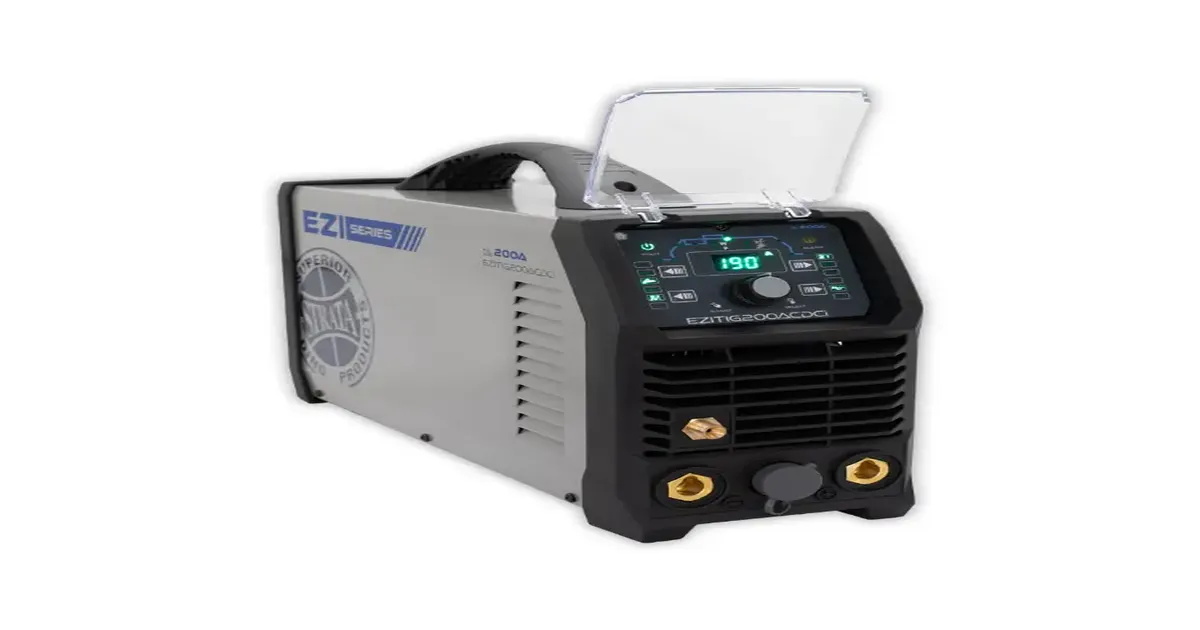
This guide covers the four faults that most often cost time on thin-wall stainless and aluminium: burn-through at the tack, distortion from cumulative heat, sugaring on the root, and contaminated tungsten at every start. It explains why an inverter TIG welder controls all four better than a transformer machine, why the inverter arc welder's function pays for itself in a workshop, and what to specify for the Strata EziTig200ACDCi now that it replaces the EziTig205ACDC.
Tacking a 1.2mm stainless tube is where a welding machine shows what it is worth. Too much heat, and you punch a hole through the wall. Too little and the tack lets go as soon as the assembly gets moved. The fix is not to turn the amps down and hope. It controls how long the arc stays live and how cleanly it starts.
That is what an inverter welder is built to do. It uses high-frequency switching rather than a heavy transformer to deliver a stable, low-amperage arc with cleaner starts and tighter heat control, which is exactly what thin-wall stainless and aluminium need. If you are a fabricator, a jobbing welder, or run a workshop on a single-phase supply, the sections below work through each fault in turn and what to specify for it.
The four problems that cost the most time
Every fabricator working with thin sections runs into the same list.
Burn-through happens when the heat input at the tack exceeds what a thin wall can absorb. It is a timing problem more than an amperage problem. A tack that lasts a fraction of a second longer than intended is the difference between a clean join and a repair.
Distortion is cumulative. Each tack that goes in hotter than it needs to pulls the assembly a little further out of square, and by the time you reach the root pass, the geometry has moved. Fixtures help. Cooler tacks help more.
Sugaring is the one people skip. The stainless tube carrying the product needs the inside back purged with argon before the root pass. Without it, the underside of the weld oxidises into a rough grey crust that traps residue and initiates pitting corrosion from the inside out, somewhere no inspector will ever see it.
Tungsten contamination can result from a scratch start or a dirty arc strike. Every contaminated electrode is a stop, a regrind and a restart. Across a day of tacking, that adds up to real hours.
Why does an inverter welder handle this better than a transformer
An inverter TIG welder switches incoming mains power at high frequency through IGBT modules rather than stepping it down through a heavy iron transformer. Three practical consequences follow, and all three point to the list above.
The arc stays stable at the bottom of the amperage range. Older transformer machines get erratic and hard to control below roughly 30A, which is precisely where thin-wall work lives. An inverter holds a usable arc well below that, so low-heat tacking becomes a setting rather than a knack.
The machine is light enough to take to the job. The current Strata unit weighs 10kg and measures 480 x 146 x 278mm. That is a machine one person carries up a ladder, not one that lives on a trolley in the corner.
It draws less from the supply for the same output. Power efficiency sits at 85 per cent, which matters on a single-phase 230V 15A circuit and matters considerably more when the supply is a generator.
Arc starting is the other half of it. High-frequency start ignites the arc without the electrode touching the work, so the tungsten stays clean. Lift TIG produces the same result with far less electromagnetic interference, which is what you want near control panels, sensors, or anything with a circuit board. Having both on one machine means you are not choosing between clean starts and safe starts.
For a fuller explanation of how polarity changes what you can weld, the Proline guide to the differences between AC and DC TIG welding covers it properly.
Matching the fault on the bench to the spec on the sheet
Most machine purchases go wrong because the spec sheet is read in isolation from the work. The table below runs the other way round. Start with the fault you keep seeing, then look at which single feature actually removes it. If a machine is missing the feature in the right-hand column, no amount of technique will fully compensate for it.
Table: Five recurring thin-wall welding faults and the machine feature that resolves each one
| Fault you keep seeing | What actually causes it | The feature that fixes it |
| Burn through at the tack | Arc stays live longer than a thin wall can absorb | Timed spot welding mode with a fixed current pulse |
| The assembly pulls out of the square | Cumulative heat from tacks that go in too hot | Stable arc at low amperage, plus pulse TIG at 0.5 to 100Hz |
| Tungsten contamination on every start | Scratch starting, or a dirty arc strike | HF start for clean ignition, Lift TIG near electronics |
| Grey, dirty welds on aluminium | Surface oxide is not being broken up by the arc | AC output with frequency adjustable from 50 to 250Hz |
| Machine cutting out mid-job | Duty cycle exceeded at your working amperage | A published duty cycle at your real amps, not the peak figure |
Sugaring is the one fault missing from that list, and deliberately so. No machine setting removes it. Adjustable gas pre-flow and post-flow protect the outside of the joint, but the inside of a tube needs a separate argon purge and the discipline to set it up every time.
Where the inverter arc welder function earns its keep
Plenty of workshops buy a machine for the TIG and then find the stick side does more hours than anyone expected. Site repairs, thicker section, outdoor work where shielding gas will not stay where you put it, cast iron, hardfacing on ground-engaging gear. An inverter arc welder handles both TIG and MMA from the same power source and output terminals, so you switch between them on one machine with one lead set rather than buying and maintaining two.
Three controls decide whether that MMA function gets used or ignored. Adjustable arc force stops the rod from stubbing when the arc shortens on a tight fillet. Hot start lifts the current briefly at strike, so the electrode lights on the first attempt on the cold plate. Automatic anti-stick drops the output if the rod freezes, so you are not wrenching a glowing electrode out of a joint. Without those three, most people give up on the stick side within a month.
Proline stocks the full range of inverter arc welders if stick work is your main use rather than a secondary one.
Reliability in a dusty workshop
The same forced air cooling that keeps an inverter light and compact also pulls whatever is in the air straight through the machine. Grinding swarf, stainless dust, timber dust, salt air on a coastal site. Over a few years, that is what kills welders, not the welding.
Two design decisions do most of the work here. A protected front panel and a sealed casing keep contaminants off the boards in the first place. And a smart cooling fan that runs only when thermal load calls for it moves far less rubbish through the machine over its service life than a fan running flat out from the moment you switch on.
The other reliability question is repairability. Multiple-board construction means a fault takes out one module rather than the whole power section, which keeps a repair economical rather than a write-off. Worth asking about before you buy, because it is the difference between a five-year machine and a fifteen-year one. The full Strata range is built to that pattern.
The current model: Strata EziTig200ACDCi
The Strata EziTig200ACDCi 200A TIG and ARC inverter welder is the current machine in this range, replacing the EziTig205ACDC. Everything that made the 205ACDC worth having is still here, with more control over the arc on top.
The core capability carries over. Same 200A ceiling, same AC and DC output, same 230V single-phase supply, same TIG and MMA combination, and the spot welding mode remains unchanged. What has been added sits in the control and process range.
Three of those additions change how the machine behaves rather than what it is rated for. Adjustable AC frequency up to 250Hz, with a choice of square or sine wave, tightens the arc cone so you can place a weld precisely on thin aluminium instead of washing heat across it. Pulse TIG across 0.5 to 100Hz provides finer heat control than a plain spot function on its own, which matters for anything that distorts easily. And 2T, 4T, and bi-level trigger modes mean that a long run no longer requires holding the trigger down for the entire weld. Remote options extend that further, with a wired foot pedal, digital up-and-down torch buttons, or a thumb-wheel potentiometer.
Duty cycle is the figure to check against your own work rather than the headline number, because it sets how long you can weld in any ten-minute period before the machine needs to cool. At 100A, it runs continuously, which covers most stainless steel sheets and thin-walled tubes. At the full 200A on AC, you get 20 per cent, or two minutes in every ten. Heavy section work will find that limit. Thin-wall fabrication rarely goes near it.
The rest is what you would expect of a machine built to AS/IEC 60974 part 1: IP21S ingress protection, surge protection for generator supply, and 48 months of cover from Strata. Full output ranges, duty cycle tables, downloads, and the instruction manual are on the product page, where you can check them against a specific job.
Who does this machine suit
If you are welding stainless assemblies, aluminium, mild steel, and the occasional stick repair off a single-phase supply, the Strata EziTig200ACDCi covers it all without compromising any process. For a jobbing fabricator, it is a genuine single-machine workshop.
If you never touch aluminium, a DC-only machine costs less and does the steel and stainless side just as well, because the AC circuitry is what you are paying the premium for. Compare the full TIG welders range, or the wider welding equipment category for MIG, plasma and consumables.
Check the circuit before the machine arrives. The EziTig200ACDCi draws up to 44A maximum input current, so if you are running it off a generator on site, make sure the supply is correctly sized and stable. Putting a 200A inverter through an undersized lead or an old extension cord is how leads overheat and how machines get damaged.
The right machine depends on your material, your thickness range and how hard you push the duty cycle. The team at Proline Industrial can size it against your actual jobs from either the Nelson or Auckland warehouse. Get in touch through the contact page or call 0800 699 353.