0800 699 353
 Parts Finder


Table of Contents
Most fabrication workshops do not lose money on the big jobs. They lose it on the small ones, where an underpowered plasma cutting machine turns a quick task into a slow one. A budget unit might handle thin sheet well enough, yet ask it to part 16 mm or 20 mm plate, and the cut slows, the edge picks up dross, and the operator is left grinding before any real work begins. Thin output current also forces a low duty cycle, so the machine needs to rest after a handful of cuts. On a busy day, that means the tool is idle while the deadline is not.
Consumables tell the same story. A weak torch and a poorly controlled arc chew through tips and electrodes, and every change is downtime plus cost. Add an air supply that the machine cannot monitor, and cut quality drifts without warning. For a general engineering shop juggling structural steel, repairs and one-off manufacturing, that unreliability is the real expense. It is not the price on the invoice; it is the hours lost and the rework that follows.
Action Engineering Tasman Ltd knows that pressure well. The Nelson-based workshop offers cutting, fabricating, milling, turning and boring, as well as welding, hardfacing, and hydraulic ram repairs. Its mix of structural steel work, ongoing repairs and maintenance, and bespoke manufacturing for local companies demands a cutting tool that simply turns up and performs. That is the standard the Strata AdvanceCut125 had to meet.
Why Action Engineering chose the AdvanceCut125
The shift came when the team replaced an older imported unit with the Strata AdvanceCut125 120 amp inverter cnc plasma cutter. For Action Engineering, this was not a small upgrade; it was a step change in power and stability. As one of the team put it, the new cutter has noticeably more power than the older unit they ran before, and that extra headroom shows in everyday cutting.
The decision was easy to defend because the value was obvious. Reliability had never been in doubt across the Strata range, and the team summed up the buying case in three words: value for money. For a workshop that has to account for every tool it owns, a machine that combines genuine output, build quality, and a sensible price is exactly what justifies the spend. The AdvanceCut125 reads less like a luxury and more like a sound investment in capacity that the business could grow into.
Theo Vamboma, the company's full-time machinist and part-time draughtsman, is the person who lives with the machine day to day. His verdict is that the Strata unit cuts cleanly, carries far more power than the Chinese cutter it replaced, and holds the standard the shop expects. When the person running the torch is satisfied, the rest of the workshop benefits.
Real-world cutting on the shop floor
Specifications matter, but the proof is in the plate. Vamboma has run the AdvanceCut125 through a range of thicknesses and found it comfortable well beyond everyday work. He has cut a 20 mm plate without trouble and expects 25 mm to pose no real problem either. For a general engineering shop, that range covers the overwhelming majority of jobs that come through the door.
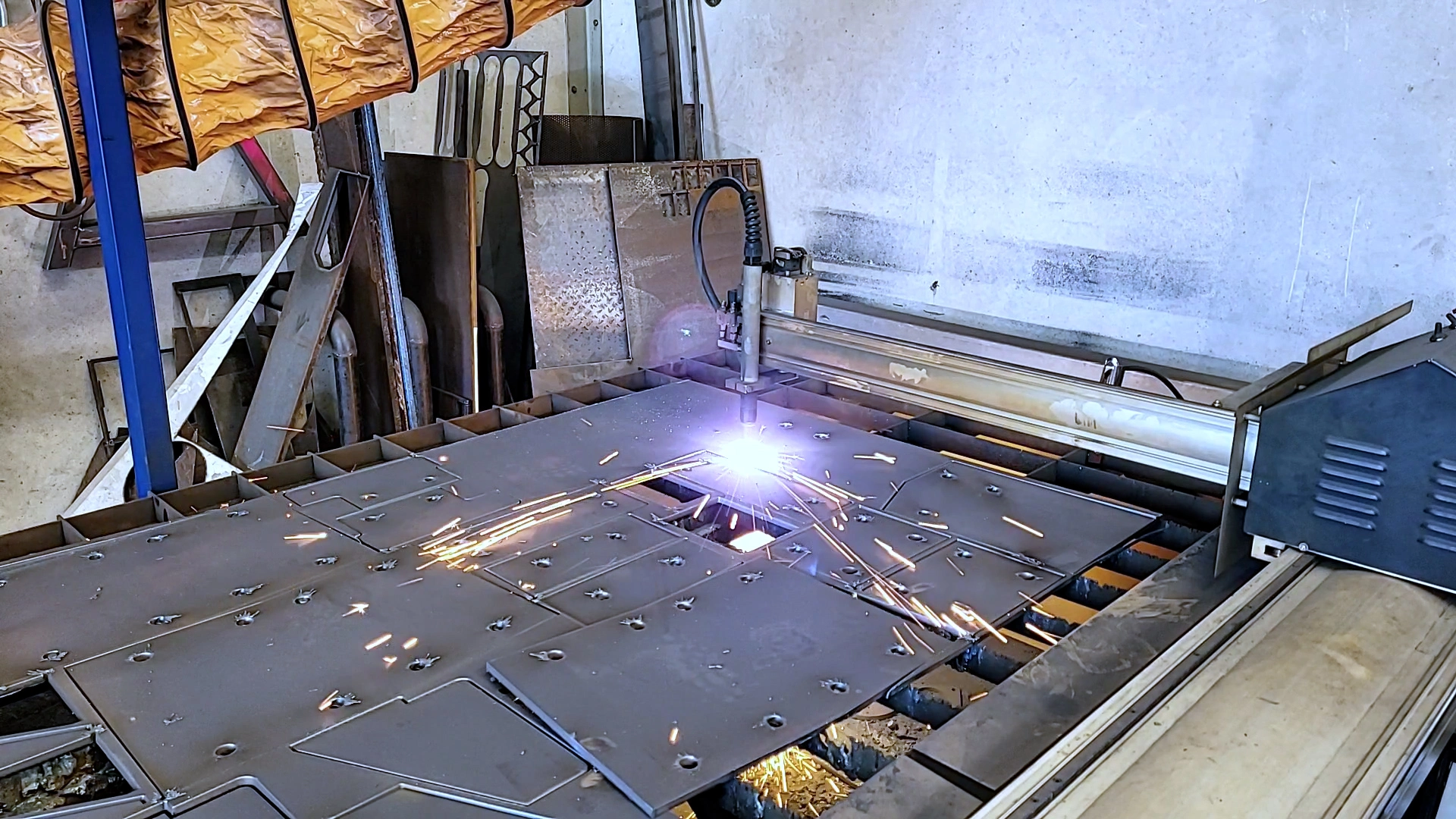
Just as telling is how the machine handles intricate work. On one job, Vamboma nested a cluster of small holes at different intervals tightly across a sheet to get the most material out of it, and cut half a sheet in around 30 minutes. That example says a lot about cutting speed, precision, and the machine's efficiency in processing each workpiece. That mix of speed and accuracy is where a capable CNC plasma cutter earns its keep, because tight nesting saves steel and clean holes save finishing time. Power on its own is easy to market. Power that translates into precise, repeatable cuts on real parts is what actually moves a workshop forward.
The other quiet win is integration. The AdvanceCut125 slotted into the company's existing setup without fuss, including its existing software, which kept downtime low and productivity steady. A new machine that demands a new way of working costs you twice, once in the price and again in the learning curve. For a workshop where the cutting bay feeds every other process, from fabrication through to final assembly, that continuity matters as much as raw output across daily operations. A reliable CNC plasma cutter is not just a faster way to part metal; it is the bottleneck that quietly disappears.
What sits inside the AdvanceCut125
The performance is not luck; it comes from the platform. At its heart, the AdvanceCut125 uses IGBT module inverter technology, which delivers a smooth, stable output, strong reliability, and a high duty cycle for continuous operation. Inverter plasma cutters typically operate at frequencies from 10 kHz to 200 kHz. On this unit, the duty cycle runs at 100 per cent at 100 amps and 60 per cent at the full 120 amps, so the machine keeps cutting through long sessions rather than stopping to cool.
Rated output is where the headroom lives. The AdvanceCut125 carries a production cut capacity of 50 mm in carbon steel and 45 mm in aluminium, with a maximum plasma output current of 120 amps. In the cutting process, CNC plasma cutters use a superheated, ionised gas and an electrical arc to form a high-velocity plasma stream that melts metal, allowing them to cut any electrically conductive metal. That is well above what most general fabrication asks for, which is exactly why the everyday 20 mm and 25 mm jobs feel effortless rather than marginal.
Ease of use is built in, too. A full-colour LCD control panel clearly displays all operating parameters, and an onboard air pressure sensor provides precise control over the air supply, since correct pressure is critical for clean cuts and long consumable life. The machine is fully compatible with automated CNC cutting equipment via its CNC interface, making it suitable for both handheld work and table-based cutting. An automated pilot arc control system lifts cutting capability on discontinuous material such as mesh and expanded metal, where the arc has to keep re-establishing itself.
Toughness rounds out the package. The unit ships with a heavy-duty Italian TH125 plasma torch, chosen for cut quality and consumable life; an intelligent torch protection system that guards against incorrect air pressure, missing consumables, and misuse of the pilot arc; and an industrial IP23 casing. Plasma jet temperatures can reach 20,000°C to 30,000°C, and electrode lifespan varies with hafnium insert dimensions as the tip wears. Strata backs the machine with a 12-month warranty that extends to 36 months upon registration.
How it compares to an average CNC plasma cutting machine
The clearest way to understand the AdvanceCut125 is to set it beside the kind of entry-level plasma cutting machine many small shops start with, especially against lower-cost setups built around lighter CNC tables and less gantry rigidity. The gap is not about one or two features; it is about whether the tool can carry a full production day.
Feature | Strata AdvanceCut125 | Typical entry-level plasma cutting machine |
Maximum output current | 120 A | 40 to 63 A |
Production cut, carbon steel | 50 mm | 12 to 20 mm |
Duty cycle | 100% at 100 A, 60% at 120 A | 35 to 60% at lower output |
| Inverter platform | IGBT module inverter | Basic inverter |
Arc starting | Dual HF and non-HF | HF only |
CNC interface | Built in | Rare or bolt-on |
Plasma torch | Italian TH125 industrial | Generic torch |
Control panel | Full colour LCD with air pressure sensor; typically requires a high-volume air supply of at least 14 CFM | Basic dial and gauge |
Torch protection | Intelligent protection system | Minimal |
Read down that table, and the pattern is plain. An entry-level cutter is fine for occasional thin sheet, but it runs out of output, duty cycle and protection exactly when a busy workshop needs them most. The AdvanceCut125 is built for the opposite scenario, where the machine has to cut thick plate, run long sessions, integrate with a CNC table and keep consumable costs sensible. Automatic torch height control helps maintain the correct cut distance and reduces consumable wear. When properly specified, a production-grade CNC plasma system can last around 20 years. That matters when buyers compare plasma with laser, weigh the advantages of a production-ready system, or consider whether a machine is properly engineered rather than simply cheaper. It also matters once movement control, from a basic 2-axis layout to additional axes on the torch head, starts affecting cut quality, with positional accuracy often falling in the ±0.010 to ±0.030-inch range. For Action Engineering, that difference is the line between a tool that limits the work and one that opens it up.
Is the AdvanceCut125 the right CNC plasma cutter for you
If your shop runs thin-gauge sheet and only cuts now and then, a smaller machine will suffice. The AdvanceCut125 is aimed squarely at the workshop that cuts structural steel, plate and mixed materials as a core part of its trade, and that wants a three-phase CNC plasma cutter able to run all day without complaint. General engineering firms, structural steel fabricators, repair and maintenance shops, and anyone moving toward automated CNC cutting are natural fits. CNC plasma tables also generally need a lower initial investment than fibre laser systems, which is an advantage for many fabrication shops, but a $60,000 hobbyist table may only last a year, making production-grade equipment the better long-term value.
For Action Engineering Tasman, the machine has done more than cut metal. It has lifted operational confidence and given the team the capacity they can rely on. The combination of skilled people and a properly specified CNC plasma cutter is what lets a workshop take on harder work and deliver it cleanly. CNC plasma cutting also spans 2D flat-profile work through to 3D setups with extra axes and a tilting head for weld preparation, with some systems cutting up to 150 mm thick and tube plasma cutting handling long sections and pipes. Common power-source benchmarks also vary widely, from the Strata AdvanceCut60 at 60A for 20 mm cuts and the Hypertherm Powermax65 cutting up to 20 mm in mild steel, to the Powermax85 with a 25 mm production pierce capacity and the Hypertherm XPR460 piercing up to 64 mm in mild steel. CNC plasma cutting is also faster than oxy-fuel cutting methods. If you are weighing up an upgrade, it is important to compare not just price but rigidity, support, and how well local manufacturers stand behind the machine in your country, because strong technical support, fast access to a qualified technician, and service available on site all help protect cut quality, uptime, and longevity over long production sessions.