0800 699 353
 Parts Finder


Table of Contents
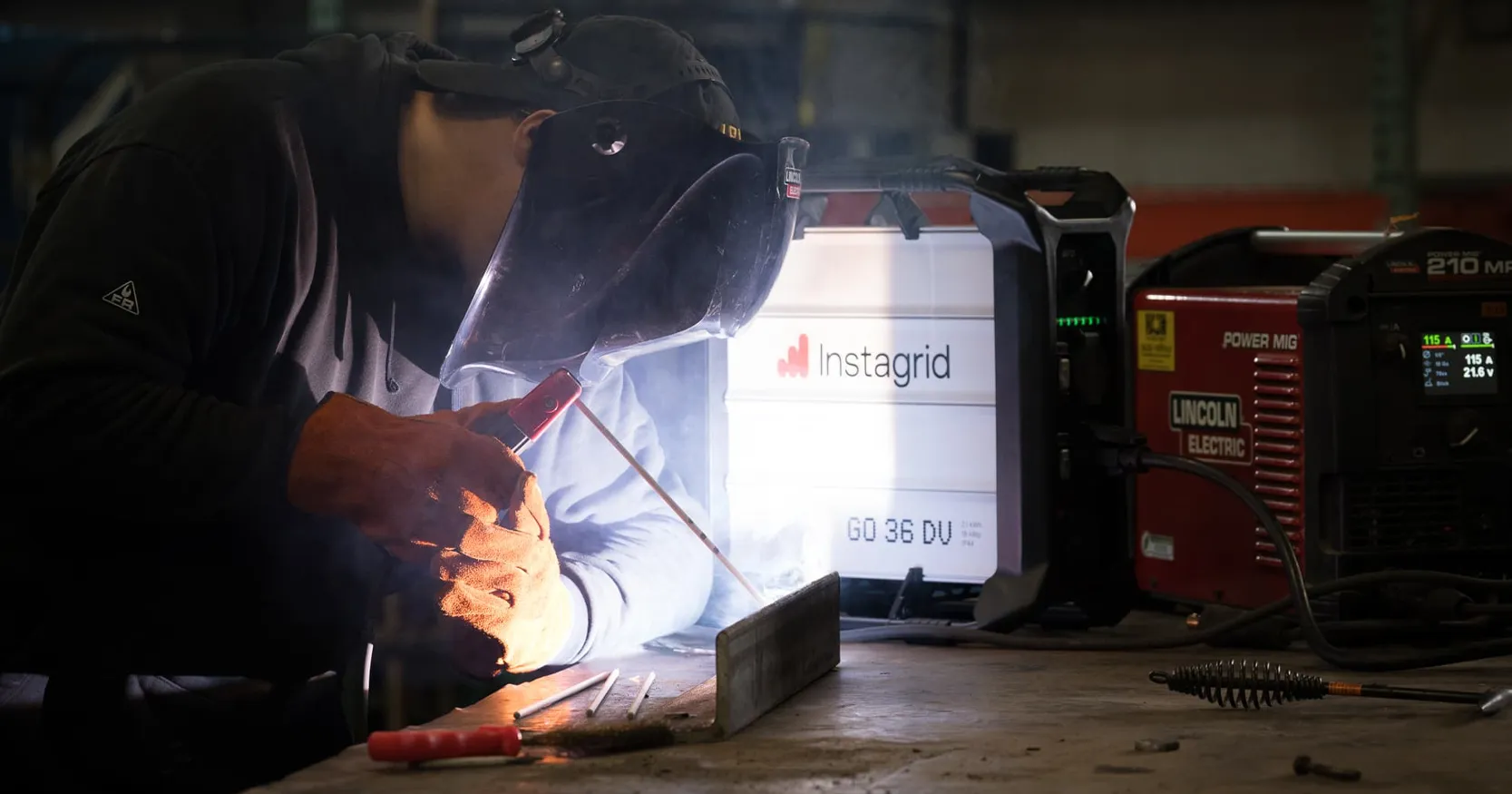
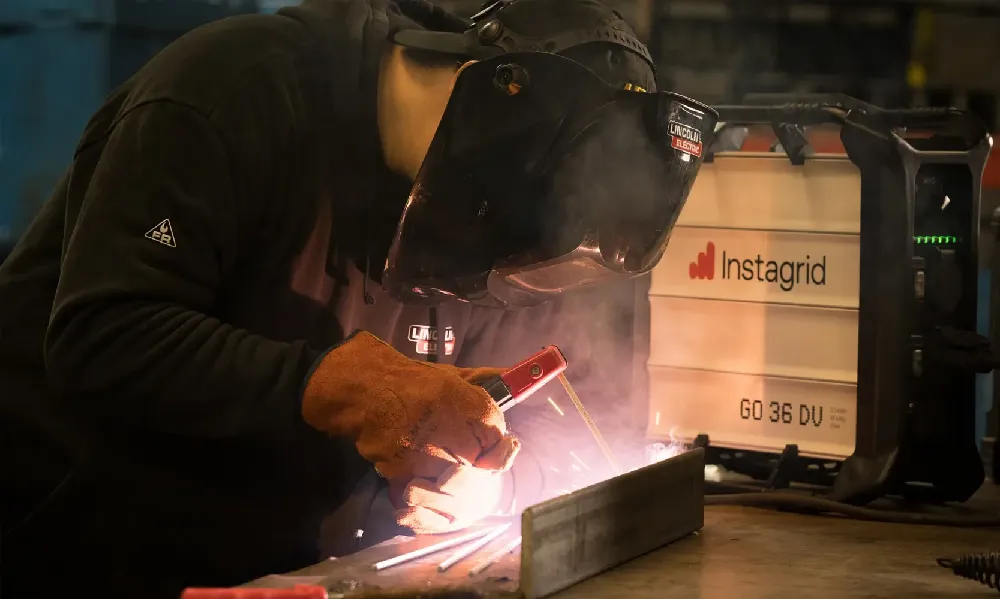
You strike an arc, the generator note drops, the arc stutters and the machine throws a fault. Every welder who has run off-site power knows that sound. A battery generator for welding NZ fabricators can actually solve it differently, by holding a stable supply through the strike instead of recovering from it. The Instagrid One portable battery power unit delivers 3,500W continuous power and 18,000W peak, with clean, stable output for many welding jobs without engine exhaust or a bulky, oversized generator.
For New Zealand welders and fabricators working off-site, especially site and maintenance crews in structural steel, pipeline, and repair work, that matters because petrol generators often sag at arc start, forcing you into larger units just to avoid nuisance faults. Here is what that buys you in practice: how battery generators work for welding, the difference between peak and continuous power, how much welding you can realistically do on one charge, where they suit the job, where they do not, including laser and three-phase welding, and what to check before you buy.
Why do welders trip generators
An inverter welder does not draw a steady load. At strike, it pulls a short, sharp inrush that can be several times its running figure, then settles. The machine assumes the supply will hold voltage through that instant.
A petrol generator cannot. Its engine has to sense the load, speed up and recover, and in the fraction of a second that takes, output voltage sags. Generator size is only part of it, because power quality matters too, and an inverter should ideally see less than 5 per cent total harmonic distortion to operate properly. Your machine sees a supply that has dropped below its operating window, or one with high THD or surging output that can damage sensitive electronics and other internal components in an inverter welder, including the computer and its capacitors, and either stutters the arc or cuts out to protect itself. Those capacitors normally charge to about 1.4 times the input voltage, roughly 335V on a 240V supply, and a voltage surge pushes that higher again, which is why unstable generator output is risky. The usual fix is to buy a much bigger generator than the welder needs, purely to survive the surge. You then carry, fuel and service that oversized machine for the rest of its life.
Instagrid make the same point about their own product. Oversizing is the industry's workaround for peak demand, and high peak headroom removes the need for it. The savings are not only in the purchase. It is the weight you stop carrying and the servicing you stop booking.
The wider cost case for battery against petrol is set out in the full petrol generator comparison. This article is about the electrical behaviour that decides whether your welder runs properly.
Peak power against continuous, in plain terms
Two numbers matter, and they do different jobs.
Continuous output is 3,500W. That is what the unit will supply all day, and it is the figure that decides whether your machine can run at the amperage you actually weld at.
Peak output is 18,000W. That is short-duration headroom for the strike, available for about a minute. It is not a run rating, and treating it as one is the most common misreading of the spec.
So the question is never whether 18,000W covers your welder. It is whether 3,500W covers your welding. A 200A stick machine welding at 130A sits comfortably inside that. The same machine wound out near its ceiling does not. Work from the amperage you actually set, not the number on the front panel, because the two are rarely the same on site.
This is also where the habit of oversizing shows up in the numbers. Industry sizing guides for petrol generators typically put stick welding at a minimum of around 6,000W, match a 160A welder with at least a 7 kVA set, and push mobile setups into the 8 kW to 10 kW range for reserve. Those figures exist because an engine must withstand the surge. A battery with 18,000W of peak headroom does not need that margin built into its continuous rating.
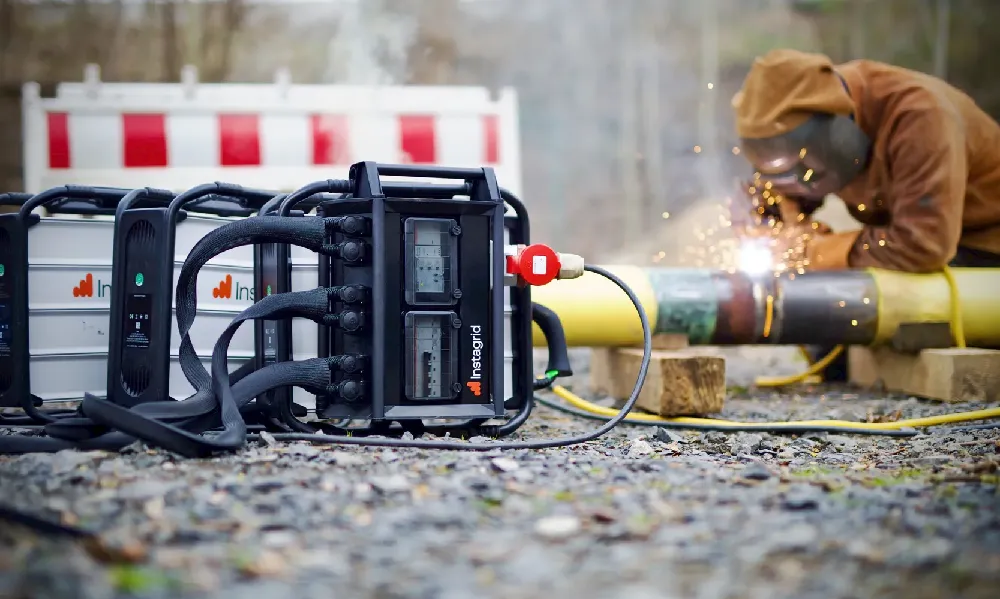
Power quality is the second half of it. Instagrid builds the unit from stacked micro-inverters, one per battery module, working together to produce a pure sine wave. Instagrid states that the output is a constant sine wave without the current interruptions that generators produce, and that welding quality benefits accordingly. As a general engineering principle, inverter welders are sensitive to a distorted or unstable supply because their front-end rectifies and switches it. Machine manufacturers commonly specify an AC source at 5 per cent THD or less, and 6 per cent is generally treated as the outer limit of acceptable for a portable generator. A clean sine wave is simply easier on that circuitry than a generator waveform under a swinging load. Proline makes no warranty claim on behalf of any welder manufacturer here. Check your machine's own supply requirements.
What one charge actually gets you
These are Instagrid operator figures, counting arc time rather than the hours the unit sits switched on between runs. Battery-powered welding options are basically split between battery-powered units that power a separate welder and portable handheld welders with the power source built in, so the setup needs to suit the job.
| Welding task | Consumable or machine | What one charge gets you |
| Stick welding, lighter gauge | 2.5mm electrodes | Around 89 rods |
| Stick welding, heavier gauge | 3.2mm electrodes | 30 to 40 rods |
| PE pipe welding | 110mm electrofusion joints | Around 26 welds |
| Supply rating | 230V, 16A output | 3,500W continuous, 18,000W peak |
| Recharge from flat | Standard 230V outlet | Back to full in two hours |
Eighty-nine rods at 2.5mm is the number worth remembering. Welding draws 2.1 kWh quickly once the arc is live, so a single unit suits intermittent duty rather than constant high-amperage work. For most site and maintenance welders, that is still more than a day of actual arc time, because arc time is a small fraction of a working day once you count fit-up, grinding, positioning, and inspection, while still giving you silent operation and zero emissions compared with fuel-powered options.
Where a battery generator for welding earns its keep
Site and structural steel tacking
Tacking is short bursts with long gaps, which is the load profile battery power suits best. In fieldwork, maximum AC output often matters more than raw battery capacity, because arc strike and surge demand determine whether the setup works. You carry 20kg to the steel instead of running back to a board, and the unit sits beside you, sealed and passively cooled. On a partly built frame that also removes a lead running across everyone else's work area, which helps on construction jobs. In New Zealand, job site use, checking local machine power ratings and surge demands is part of choosing a capable battery setup.
Pipeline and PE butt fusion
Electrofusion is a controlled, timed process where a dip in supply during the cycle can ruin the joint, and a ruined joint in a live main is an expensive afternoon. Stable output matters more here than raw capacity. Around 26 joints at 110mm on one charge covers a solid day in a trench, with no generator sitting on the verge above you and no lead running down into the excavation.
Maintenance welding inside an occupied plant
This is the access argument. No exhaust means no carbon monoxide, and WorkSafe NZ advises using electric rather than fuel-powered equipment in poorly ventilated areas wherever it is reasonably practicable. Noise output under 10 dB(A) means no hearing protection argument with the facility over your power source, only over your grinder. On a shutdown where the plant next door is still running, that can be the difference between working and waiting.
Repair work, you cannot run a lead to
Tank tops, roof steel, remote pipework, anywhere a 50 metre lead is the reason the job takes two people. The unit goes where you go, and at the end of the day, it comes back down with you rather than staying out on site.
Battery-powered laser welding, duty cycle, and what the numbers actually say
Handheld laser and TIG welding are the obvious next questions where clean power, precision, and even delicate aluminium work matter, and they deserve a straight answer rather than a cross-sell.
The Strata SLR3000 runs on 230V single-phase, so it physically connects. Its maximum input is 3,800W, exceeding the unit's 3,500W continuous rating. Strata also rate it for a 100 per cent duty cycle and continuous operation, which is the opposite of the intermittent pattern assumed by the run time figures. The SLR5000 draws up to 5,400W and is available on a single unit.
So the honest position is this. Portable laser welding on battery power is a linked-unit conversation, not a single-unit one. If that is your application, size it around multiple units from the start and talk to us before you buy either piece. Browse the welding equipment range with that in mind.
Where it will not work
Heavy continuous production welding is out. A 2.1 kWh battery is not a substitute for a workshop supply on a machine running all shift, and no amount of linking changes those economics for a fixed bench.
Three-phase industrial welders will not run on a single 230V unit, nor will 32A machines.
Long-duty-cycle work without linked units is the third limit. If you are welding at high amperage with short gaps, model your actual arc time against 2.1 kWh before you commit, rather than trusting the rod count.
And anything drawing over 3,500W steadily is out, regardless of how comfortable the 18,000W peak figure looks.
When you need three-phase
For 400V machines, you need the linking hardware. Instagrid Link Max combines three Instagrid One units into a portable 400V three-phase supply rated at 11 kW continuous and 54 kW peak, covering three-phase industrial welders and larger fabrication plants. Note the distinction. Instagrid Link triples energy capacity to 6.3 kWh but remains single-phase, while Link Max produces 400V.
What to check before you buy
What amperage do you actually weld at?
Not the machine's maximum, your working setting. That drives the real draw against 3,500W.
What is your arc on time per day?
Count it honestly. Most site welders are surprised by how low it is, and it is the figure that the run times are measuring.
Stick, MIG, TIG or electrofusion?
Duty cycle and draw differ sharply, and so does the answer.
Is any machine in your kit three-phase or 32A?
Size around the linking hardware from the start rather than adding it later.
Where does it charge?
Two hours on a standard outlet, so a yard, a van or a site board needs to be in the cycle somewhere.
What does your machine's manual say about the supply? Follow that, not a generic claim about battery power. Confirm the plug type, any required cables, and how everything is connected before you arrive on site, including the correct wire size where relevant.
It is worth seeing where this sits in the wider portable power stations category, and the Instagrid range covers the linking hardware alongside the base units.
Talk to us about your machine
Give us your welder, your working amperage and your daily arc time, and we can tell you whether one unit covers it. Enquire through the Instagrid One product page or call the team on 0800 699 353.