0800 699 353

 Parts Finder


Table of Contents
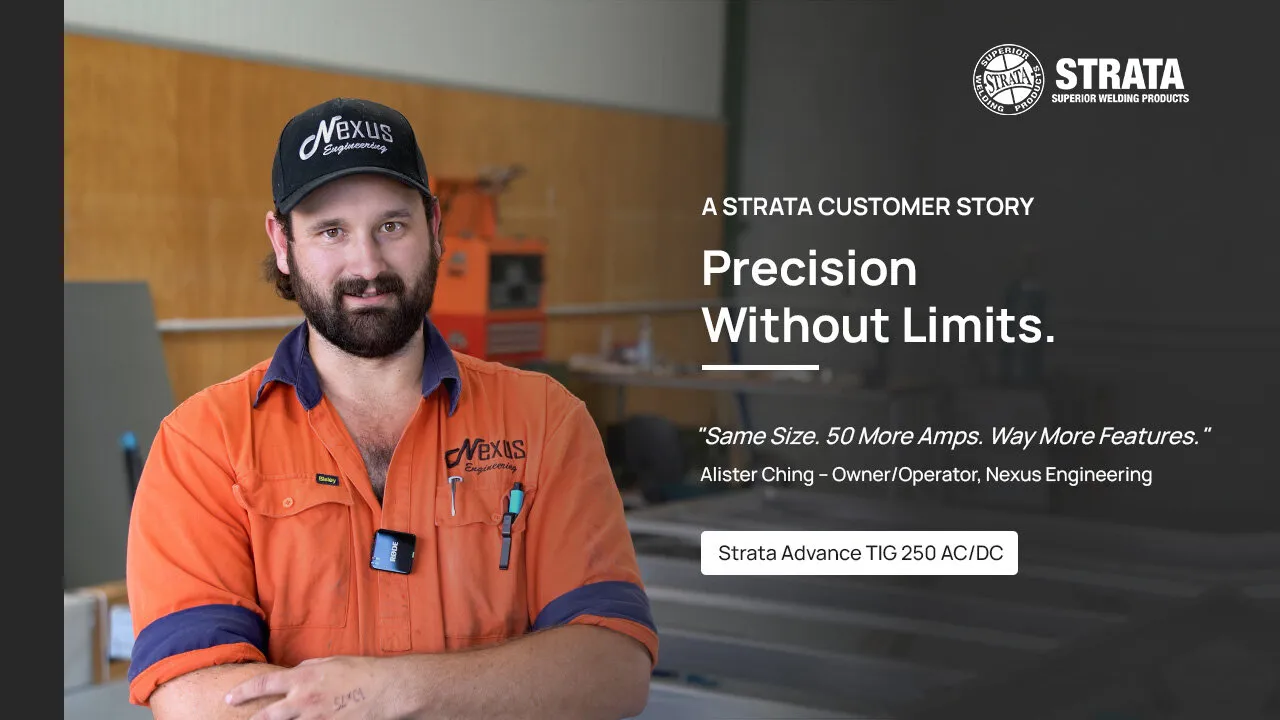
A 250A AC/DC inverter TIG welder can handle aluminium, stainless steel and mild steel in one workshop on ordinary single-phase power, provided its duty cycle suits your work. What matters most is how low it goes for thin material, how finely you can shape the AC arc, and how quickly you can change jobs. This guide starts with one workshop's experience, then covers where this machine is the wrong tool.
It suits jobbing workshops welding mixed materials at short notice. If you mostly run a single material at a steady current, you may not need this flexibility. Proline Industrial sells every product mentioned here, so treat the customer's comments as one workshop's experience rather than independent testing. Where a figure comes from Alister rather than a product page, we say so.
Meet Nexus Engineering
Nexus Engineering is a jobbing workshop. Its owner, Alister, describes welding stainless in one hour and heavy aluminium the next, often for someone who needs it done quickly. Time lost between tasks is the pressure: walking to another machine, wheeling it over, setting it up, then doing it all again for the next job. His previous welder was a 200A machine he bought about ten years ago. He shares his experience, linked at the end.
The products at a glance
Strata AdvanceTig250ACDC: A 250A AC/DC pulse TIG and stick inverter welder. TIG output ranges from 5 to 250A, with 20 job memories and four AC waveforms (sine, square, triangle, and mixed). A TIG Smart Set mode suggests settings based on material, thickness, and joint type. It weighs 15kg, measures 580 x 189 x 350 mm, and runs on 230 V, 15 A, single-phase, with an IP23 casing. It ships with an 8m PRO26 torch, leads and regulator. Wired and wireless foot pedals are optional.
- Best for: mixed-material workshops that need low-amp control and AC aluminium work.
- Not for: three-phase production work or sustained full-current welding.
Strata AdvanceTig Compact Water Cooler: An optional 10kg cooler (10 L/min, 4 L coolant) that mounts to the welder and connects via a single cable. A pressure sensor stops welding unless coolant is circulating, and colour-coded quick-connect fittings make hookup tool-free. It is made for single-phase TIG machines.
- Best for: long, hot welds, especially on aluminium.
- Not for: short, low-current jobs without a water-cooled torch.
Strata STG12 12V Cordless Tungsten Grinder: A battery tungsten sharpener with five angles (10° to 25°), five sizes (1.0 to 3.2mm), six speeds up to 30,000 RPM and a built-in cutter for balled or contaminated tips. It charges via USB-C and comes with five diamond discs, three mandrels and a storage bag. The page rates each disc side at roughly 200 sharpenings.
- Best for: TIG welders who sharpen often, at the bench or on site.
- Not for: replacing PPE or dust controls, or tungsten thicker than 3.2mm.
How Nexus uses them: 4 use cases
Use case 1: Jobbing work that changes material all day
The job: A stainless job lands, then a heavy aluminium job, and the customer wants both quickly.
What they do: Alister scrolls to a stored setting, swaps the tungsten and adjusts the gas. He puts the changeover at about 30 seconds, whereas wheeling over a second machine took far longer. With 20 memories, the settings for stainless and heavy aluminium sit a scroll apart, and he says downtime has dropped a lot.
Use case 2: Aluminium that runs hot
The job: Long, hot aluminium welds are hard on torches.
What they do: With the cooler fitted, Alister says he is "not burning out torches". The AC waveforms and 50 to 250Hz frequency range let him tune cleaning and penetration. The machine lives on a trolley with its cooler but loads into a vehicle for site work. Alister also points to size: the 250 is about the same size as his old 200, with another 50 amps and many more features. He names that as one of the biggest selling points.
Worth knowing: The trolley is extra, and torch life is Alister's own observation.
Use case 3: Thin and delicate material
The job: Low heat on thin metal, including what he calls "welding razor blades" last week.
What they do: The machine's TIG range starts at 5A, and Alister says it holds a stable arc there, with the high-frequency start responding well. His previous 200A machine could not go as low. A spot welding mode is also listed for very thin work.
Worth knowing: 5A is a spec; results on very thin material still depend on technique.
Use case 4: Sharpening tungsten at the bench
The job: Walking across the workshop to a grinder just to sharpen a tip.
What they do: The STG12 sits on the bench. Alister says you can "just pick this up and go for it", and he would put one at each bench. Different angle and size slots let him seat the tungsten in the collar for any of the 25 angle and size combinations, and he says it takes a fraction of the time. Asked about plans, he says a second welder is definitely coming.
Worth knowing: The product page also lists a built-in cutter for contaminated tips, which Alister does not mention. He linked this use to skipping PPE. We do not recommend dropping PPE or dust controls; follow your workplace's rules and WorkSafe NZ welding guidance. The welder and cooler list a 48-month warranty; confirm terms at purchase.
Limitations: who this welder is not for
• Three-phase supply: this machine is single-phase. Browse other TIG welders for higher-output options.
• Sustained full current: DC duty cycle is 250A at 30%, and 160A at 100%.
• Extra costs: cooler, trolley, foot pedal and consumables are separate.
• One workshop's story: these results are one customer's experience, and the product pages have no reviews yet.
• Torch compatibility: the cooler only helps with a water-cooled torch, so confirm which torch suits your setup.
• Large tungsten: the STG12 stops at 3.2mm, so bigger electrodes need another sharpener.
• DC-only work: if you only weld steel, read our AC and DC TIG explainer first.
How to decide
| If your work is mostly | Check this | What Nexus found |
| Mixed materials, changing often | Memory settings, AC and DC in one unit | About 30 seconds to change over |
| Thin sheet or fine work | Minimum amps (5A) | Stable at low heat |
| Long aluminium welds | Duty cycle, water cooler | Fewer burnt-out torches |
| Workshop and site | 15kg welder, 10kg cooler, generator size | Loads into a vehicle |
| Frequent tungsten changes | Tungsten sizes, 1.0 to 3.2mm | Quicker at the bench |
| One material, steady current | Do you need AC at all? | You may not need this |
Call the team on 0800 699 353, ask about Click & Collect from Nelson and Auckland, or use our spare parts finder.
Watch the Nexus Engineering videos
Hear it from the workshop: