0800 699 353
 Parts Finder


Table of Contents
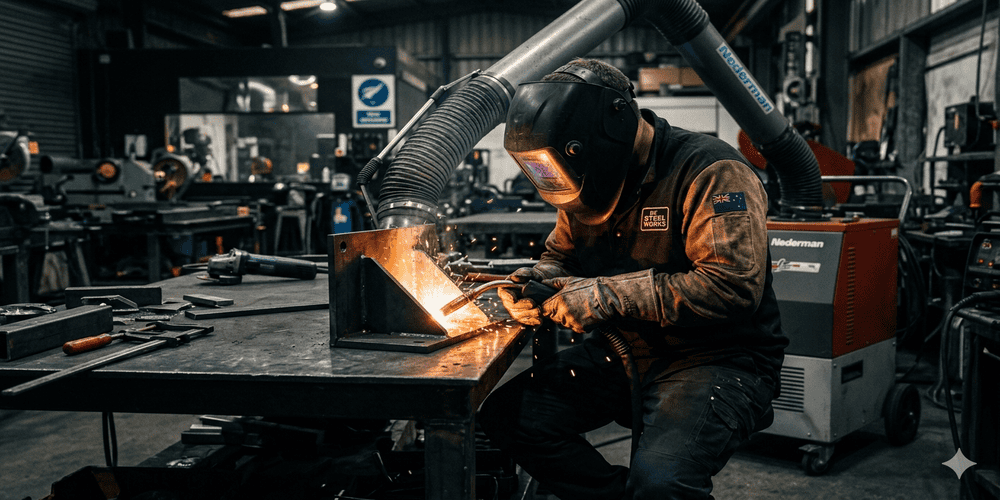
For professional fabricators and structural engineers across New Zealand, the choice of welding wire is never trivial. The wrong consumable can delay an entire project, cause costly rework, or create unsafe working conditions. When Nelson-based Trinder Engineers found themselves fighting a persistent CO2 gas supply problem, they needed a smarter solution fast. Their answer was the Hyundai SC-420MC dual-shield flux-cored MIG wire, and the results exceeded every expectation.
This case study explores why Trinder Engineers made the switch, how the SC-420MC flux-cored wire performed on a demanding real-world infrastructure project, and what fabricators across New Zealand should know before choosing their next MIG wire.
The Challenge: CO2 Supply Issues with Hyundai Supercored 71H
Trinder Engineers had long relied on the Hyundai Supercored 71H, a well-regarded E71T1 titania flux-cored CO2-shielded MIG wire widely used in structural steel and general fabrication. The 71H delivers consistent arc performance and solid all-position capability, making it a trusted choice for workshops running high-volume weld schedules.
However, the 71H wire has one firm dependency: CO2 shielding gas. As supply chains tightened across New Zealand, obtaining a reliable flow of CO2 cylinders became increasingly difficult for the Trinder Engineers team. Delays in gas supply led to delays on the workshop floor, resulting in missed project milestones and unnecessary operational pressure.
As Prosser, an experienced fabricator at Trinder Engineers, explained: "We just switched to that SC wire from the old 71H because it was hard to get the CO2 gas."
Rather than work around the problem indefinitely, the team decided to evaluate a flux-cored wire with greater shielding gas flexibility.
What Is the Hyundai SC-420MC? Understanding Dual-Shield Rutile Flux Cored Wire
The Hyundai SC-420MC is a dual-shield, all-position rutile flux cored wire classified to AWS E71T-1. It is available in 1.2mm and 1.6mm diameters on 15kg spools and is suited to a wide range of structural and fabrication applications.
The term "dual-shield" is important. Unlike a single-shield flux cored wire that relies solely on gas generated from the flux core, dual-shield flux cored wire uses both the flux core and an external shielding gas. The SC-420MC can operate with CO2 alone or with a mixed argon/CO2 shielding gas, giving operators genuine flexibility depending on what shielding gas is available on site or in the workshop.
This flexibility is precisely what resolved Trinder Engineers' supply chain problem. When CO2 was scarce, the team could switch to a mixed gas without changing their wire or adjusting their WPS significantly. The SC-420MC flux-cored wire worked reliably with both shielding gas options, keeping the workflow running without interruption.
Key technical characteristics of the SC-420MC include:
- Classification: AWS A5.20 E71T-1 (all-position)
- Shielding gas: CO2 or Ar/CO2 mix
- Diameters: 1.2mm and 1.6mm
- Spool weight: 15kg
- Applications: Structural steel, bridges, shipbuilding, vehicle fabrication, chemical plant machinery, general metal fabrication
For fabricators seeking a high-performance MIG wire that does not lock them into a single gas type, the SC-420MC presents a compelling case.
The Maitai Golf Course Bridge: SC-420MC in Action
The most significant project Trinder Engineers undertook with the SC-420MC flux-cored wire was the construction of a replacement bridge for the Maitai Golf Course. The previous bridge had been destroyed by severe flooding, and the new structure needed to meet stringent engineering and compliance standards.
The brief called for a 36-metre-long bridge built in three separate sections. Every joint, every weld, and every pass was catalogued, numbered, and recorded as part of a thorough quality management process. There was no room for inconsistency. The SC-420MC was selected from the outset because of its ability to produce high-quality, repeatable welds with minimal cleanup between passes.
Structural steel bridge fabrication places specific demands on a MIG wire. Out-of-position welding, particularly vertical-up runs on web and flange connections, requires a wire that maintains arc stability and controls the weld pool without excessive heat input. The SC-420MC delivered precisely this. Its low-spatter arc, excellent slag release, and controlled bead profile made vertical weld passes straightforward, even for less experienced operators on the team.
Prosser noted that the SC-420MC proved "much more forgiving than the old wire," particularly in vertical weld applications, which are notoriously demanding even for seasoned fabricators.
Performance Benefits: Why the SC-420MC Outperforms Traditional Flux Cored Wire
Based on experience with Trinder Engineers, the SC-420MC offers clear performance advantages over many conventional flux-cored MIG wires.
Reduced Spatter and Fume Generation
One of the most immediate improvements the Trinder Engineers team noticed was the reduction in spatter. Less spatter means less time spent grinding and cleaning between passes, directly reducing labour costs on high-volume fabrication projects. It also means a cleaner working environment, which is important for workshops where health and safety are taken seriously.
Welding fume generation was also noticeably lower with the SC-420MC compared to the Hyundai Supercored 71H. For shops that weld in enclosed or partially enclosed spaces, lower fume output reduces the burden on extraction systems and helps meet workplace exposure standards.
Excellent Vertical Weldability at Low Current
The SC-420MC is specifically designed to excel in out-of-position welding, including vertical-up applications. By delivering a stable arc at relatively low current settings, it gives the operator better control over heat input and weld pool behaviour. This makes it significantly easier to produce uniform, correctly profiled welds in the vertical position without resorting to a weave technique, saving time on every pass.
Superior Arc Stability and Crack Resistance
The SC-420MC produces a smooth, stable arc that is consistent across a wide range of parameters. This consistency is critical in structural work, where operator variability can introduce quality risks. The wire also offers excellent crack resistance, an important property in applications subject to dynamic loading such as bridges, vehicle chassis, and crane components.
User-Friendly for All Skill Levels
Perhaps the most telling feedback from Trinder Engineers came regarding apprentice welders. In a workshop environment, newer operators are often given simpler tasks while they develop their technique. With the SC-420MC, apprentices were able to complete complex structural welds with confidence from the outset. As Prosser put it: "This stuff just seems much more user-friendly and easier to use."
For workshop managers, this is a significant operational benefit. A forgiving, easy-to-set-up flux-cored MIG wire reduces training overhead on each new job and limits rework that can otherwise arise when less experienced operators tackle challenging positions.
Cost Efficiency: Getting More from Your MIG Wire Budget
Switching welding consumables always prompts the question of cost. Prosser summed it up plainly: "Everyone's happy if the gas is cheaper and the wire works just as good."
The SC-420MC delivers on both counts. Its compatibility with argon/CO2 mixed gas means workshops can take advantage of mixed gas pricing, which in some markets is more stable and accessible than bulk CO2 alone. Combined with reduced spatter cleanup time, lower fume extraction load, and greater first-pass success rates, the total cost of use for the SC-420MC compares favourably with alternatives, even when the per-kilogram price of the wire itself is similar.
For fabricators running projects with tight margins and firm delivery schedules, these efficiency gains compound quickly across a full welding programme.
Browse the full range of MIG wires available at Proline Industrial to compare options for your application.
Who Should Consider the Hyundai SC-420MC?
The SC-420MC is not a niche product. Its all-position classification, dual-shield capability, and broad application range make it suitable for a wide variety of structural and fabrication workshops. It is particularly well-suited to:
Structural steel fabricators working on bridges, buildings, and infrastructure
Workshops with mixed or variable gas supply that need a wire that tolerates both CO2 and Ar/CO2
Shops training apprentices, where a forgiving, easy-to-dial wire reduces rework
Projects with rigorous quality management requirements, where weld consistency and traceability matter
Applications requiring out-of-position welding, including vertical-up and overhead passes
If your team is currently using the Hyundai Supercored 71H and experiencing any of the challenges described above, the SC-420MC is a direct, proven upgrade path worth evaluating.
Conclusion
Trinder Engineers' shift to the Hyundai SC-420MC demonstrates something that experienced fabricators know well: the right welding wire does more than produce a bead. It determines how smoothly a workshop runs, how consistently apprentices and experienced welders can hit quality targets, and how resilient an operation is when supply chains become unpredictable.
The SC-420MC flux-cored MIG wire resolved a genuine supply chain problem, improved weld quality and operator experience, and proved itself on a demanding structural infrastructure project. For New Zealand fabricators seeking a reliable, versatile, and user-friendly flux-cored wire, this product warrants serious consideration.
View the Hyundai SC-420MC Dual-Shield Flux Cored MIG Wire or explore the full MIG welding range at Proline Industrial.