0800 699 353
 Parts Finder


Table of Contents
If your workshop still relies on an extractor bought several years ago, 2026 is the year to check it properly. A new joint Australian and New Zealand standard, AS/NZS ISO 21904, now tests a fume extractor as a complete machine rather than judging the filter alone. In July, WorkSafe New Zealand also confirmed its exposure standards for welding fume as permanent rather than interim. Here is what has changed and how to judge whether your equipment is up to spec.
Disclosure: Proline Industrial sells welding fume extractors, including the machine featured below. We name our sources in the text so you can check our claims.
Why is welding fume taken so seriously
Welding fume is a mixture of fine metal particles and gases, and its composition depends on the metal, the consumable, and any coating on the workpiece. The International Agency for Research on Cancer (IARC) classifies all welding fume, including mild steel fume, as carcinogenic to humans (Group 1). WorkSafe’s own guidance describes exposure as a known cause of lung cancer and possibly kidney cancer in welders, and says there is no known safe level of exposure.
Cancer is not the only concern. WorkSafe links stainless steel fume to occupational asthma and galvanised steel to metal fume fever. Under the Health and Safety at Work Act 2015, a business (a PCBU) must eliminate risks to health so far as is reasonably practicable and, where that is not possible, minimise them. For welding fume, that almost always means capturing it at the source.
What AS/NZS ISO 21904 changes: the whole machine is tested
In March 2026, Australia and New Zealand adopted the ISO 21904 series as AS/NZS ISO 21904. The headline change is simple. Extraction equipment used to be judged mostly on its filter: could the media trap particles? Under the new series, the entire assembled unit is tested for particle removal efficiency, including how well fume is contained before it reaches the filter and whether the ducting leaks air.
A system assessed in the series must demonstrate:
- Filtration efficiency of at least 99% for welding fume (the W3 class)
- Verified performance of the whole device, not just the filter media
- Airflow monitoring with warnings and alarms
- Safe filter handling and dust management
- Minimum capture velocities and validated torch or hood performance
Two caveats are worth knowing. First, ISO 21904 is a product standard rather than legislation, although it is quickly becoming the benchmark that suppliers and safety advisers point to. Second, it is aimed mainly at equipment in which captured fume is filtered and returned to the workshop, which is typical of portable extractors.
What WorkSafe confirmed in July 2026
On 23 July 2026, WorkSafe New Zealand released plain-language guidance on workplace exposure standards (WES) and confirmed the WES values for welding fumes, as well as for flour dust, softwood dust, and hardwood dust. Confirmed values are no longer interim, giving businesses and occupational hygienists greater certainty about what they are measuring against.
It helps to be precise about what that means. WorkSafe describes WES as guideline values for assessing airborne exposure, not compulsory limits or standalone enforcement thresholds. Your duty remains the general one: manage the risk, and be able to show how.
What compliant extraction looks like in practice
Putting the standard and the guidance together, a well-controlled workshop typically has the following:
- Whole-unit evidence. Documentation showing W3 performance for the complete extractor, not only a filter data sheet.
- Capture at the source. WorkSafe’s fact sheet on welding and local exhaust ventilation (LEV) suggests on-tool extraction for MIG welding, a moveable hood or arm for oxy-gas work, and a water or downdraught table for plasma cutting. General ventilation supports these controls but does not replace them.
- Airflow monitoring. A filter alarm or indicator that warns you when a clogged filter is cutting off extraction.
- Good positioning. Capture weakens quickly with distance, so the hood or arm needs to sit close to the weld. WorkSafe also advises enclosing the welding area where possible, because draughts can blow fume away from the hood.
- Exposure monitoring. WorkSafe recommends monitoring by an occupational hygienist or other suitably trained person, because LEV will not always capture enough to keep exposure down.
Will your existing extractor pass?
An older extractor is not automatically non-compliant, but five questions will tell you quickly whether it deserves a closer look.
- Can you produce W3 or ISO 21904 documentation for the whole unit?
- Does the machine tell you when its filter is clogged, and when was the filter last cleaned or replaced?
- Can the arm or hood sit close enough to the arc to catch the plume?
- Do your welders actually use it, or does it sit in a corner because it is awkward to move?
- Has anyone measured the air your team breathes?
If the answer to any of these is no or “not sure”, the system is worth auditing. An occupational hygienist can measure exposure, and your equipment supplier can check airflow at the hood and the condition of the filter.
Choosing the right type of extraction for your workshop
There is no single best machine. The right choice depends on the work.
- Portable extractors with flexible arms suit varied fabrication work, because you wheel them to the job and position the hood by the weld. Our welding fume extraction range covers mobile units in several sizes.
- On-torch extraction captures fume at the gun and suits repetitive MIG work. Proline stocks Binzel xFUME and Strata MFG365 extraction torches.
- Downdraught tables work well for smaller parts, grinding and plasma cutting, where fume rises from a flat work surface. See the Strata Airforce FE210TABLE.
- Respiratory protection such as a powered air-purifying respirator (PAPR) is the last line of defence. It complements extraction but should not replace it.
A W3-rated fume extractor from Proline
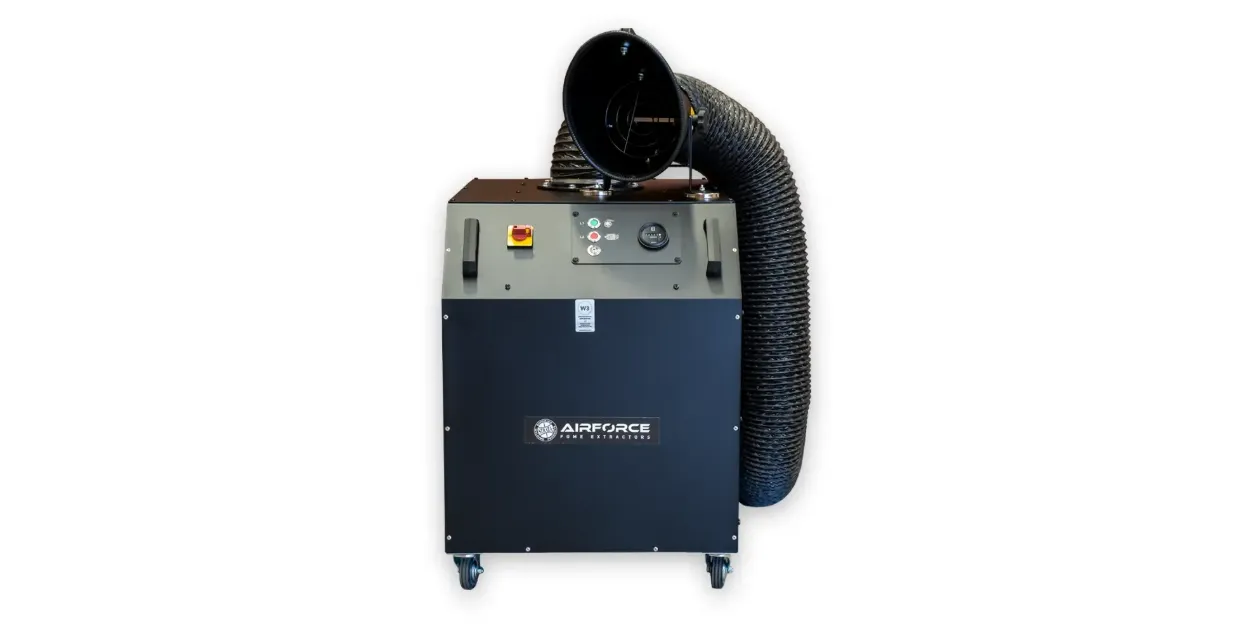
The Strata Airforce FE210ARM shows what the new benchmark looks like in a mobile unit. Its specification lists W3 filtration above 99% to ISO 21904-1/2. It has a 3 m heavy-duty flexible arm with an adjustable hood and damper, and a fan capacity of 2,500 m³/h, with 1,100 m³/h at the hood. A differential pressure alarm flags a clogged filter and runs on a single-phase 230V supply.
The wider Strata Airforce FE210 range adds a hood version and the downdraught table model above for different jobs. Not every extractor we stock carries a W3 rating, so check the specification of the model you are considering, or ask us. You can browse our entire range of fume protection equipment on our page.
What to do next
Audit what you already have using the five questions above, ask any supplier, including us, for whole-unit W3 or ISO 21904 documentation before you buy, and consider air monitoring so you have real exposure numbers rather than assumptions.
If you would like help matching an extractor to your welding processes, contact the Proline team or visit our Nelson or Auckland warehouse. For more practical guides, browse our Knowledge Hub.