0800 699 353

 Parts Finder


Table of Contents
Optrel Swiss Air Quick-Start Guide NZ: Set Up, Fit and Look After Your PAPR
Proline Industrial sells the Optrel Swiss Air, so we have a commercial interest in it. This guide follows Optrel's user manual.
About this guide: This Optrel Swiss Air quick-start guide shows New Zealand welders, fabricators, and engineers how to set up, fit, and maintain the Optrel Swiss Air PAPR, a TH3P-powered air-purifying respirator, in nine simple, practical steps. It covers charging the battery, fitting the filters, sizing the harness, putting on the mask, doing the seal check, understanding the alarms, adding a helmet and cleaning the unit. You will also see where this welding fume respirator should not be used, hear how Smith Engineering and R E M Ltd use it, and find Proline's own video walkthroughs to follow along.
What is the Optrel Swiss Air PAPR, and what does it not do?
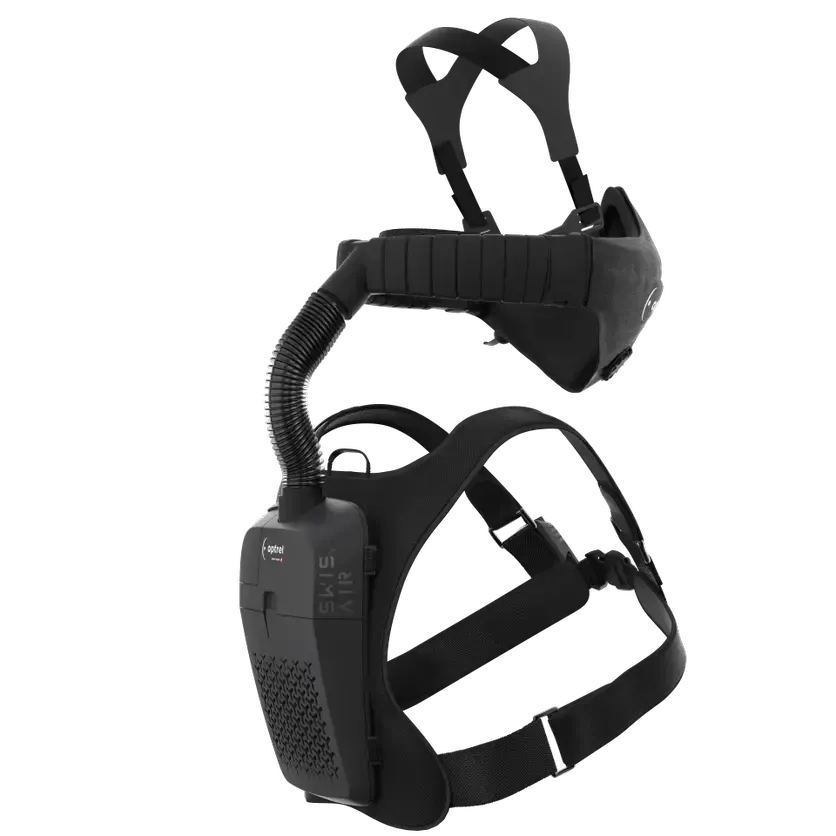
The Swiss Air is a powered air-purifying respirator (PAPR) with a half-mask. A small blower pushes filtered air to the mask, so you are not dragging air through a filter with your own lungs. Optrel's manual lists it as TH3P under EN 12941 and P3 under AS/NZS 1716, and our product page quotes 99.8% particle filtration.
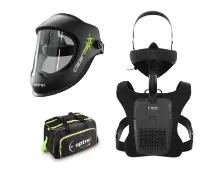
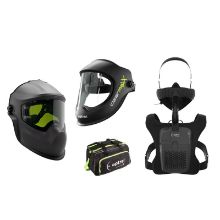
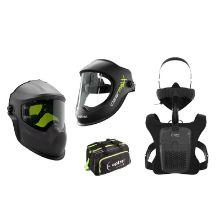
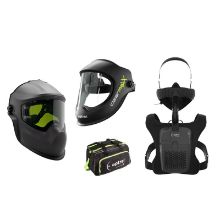
What is in the box: this unboxing video goes through the system item by item: battery, charger, filter, harness, control unit, mask, and mask storage. Check each part and the hose for damage. If anything is missing or damaged, do not use it; call us on 0800 699 353.
Step 1: Charge the battery
Charge the battery fully before first use. Slide it out, connect the charger, and wait for the LED to turn green. Charge indoors, away from heat and combustible materials, and between 0 and 45 degrees Celsius. Allow several hours.
Step 2: Fit the filters
Seat the spark guard, the pre-filter and the main particle filter, then close the cover until it clicks. Never run the unit without an Optrel particle filter.
Step 3: Size the harness
Measure your chest and set the harness to XS to M or M to XL. Put it on, close the belt hook, then adjust the shoulder size and width so the blower sits comfortably.
Step 4: Put on the mask
Connect the mask to the Y-hose so it clicks. Check the air connector points down, loosen the neck strap, attach one side of the mask and tighten the neck strap until it rests on your neck. Click in the other side and pull the headband tabs until it is snug but comfortable.
Keep headscarves and headgear out from under the seal. A beard is fine, according to Optrel.
Step 5: Switch on and set the airflow
Hold the power button for about two seconds. Three beeps sound, and the unit runs a short self-test. Briefly press the button to cycle through three airflow levels, which are 100, 115 and 130 litres per minute, indicated by one, two or three beeps.
Step 6: Do the seal check every time
Set level 1, breathe in quickly, and the mask should pull towards your face. If it does not, the seal is not good. Re-seat the mask and retest. Optrel says no formal fit test is needed, but this check is not optional.
Step 7: Know the alarms
A fast beep (0.25 seconds on, 0.25 seconds off) indicates a clogged or missing filter, or low airflow. A slower beep (1.5 seconds on, 1.5 seconds off) indicates a low battery and roughly 15 minutes remaining. With either alarm, leave the work area first, then replace the filter or battery.
Change the pre-filter at the first filter alarm. Used filters cannot be cleaned or reused.
Step 8: Add a helmet for sparks and spatter
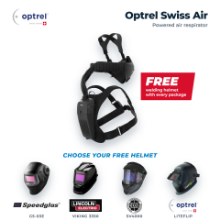
The Swiss Air does not protect your eyes or face from sparks. For grinding, add a Clearmaxx; for welding, wear a welding helmet over the mask. Our product page says it fits under any welding helmet.
Step 9: Clean, store and maintain
Wipe the blower and hose with a cloth dampened with soapy water and let them dry at room temperature. Hand-wash the mask with household detergent. Avoid solvents, pure alcohol and abrasive cleaners. Never immerse the blower or battery.
Store it dry, out of sunlight and away from solvent fumes. Recharge the battery every four months if it is in storage. Optrel recommends replacing the hose seal at least once a year and an annual service by an Optrel-qualified specialist.
How tradespeople use the Swiss Air
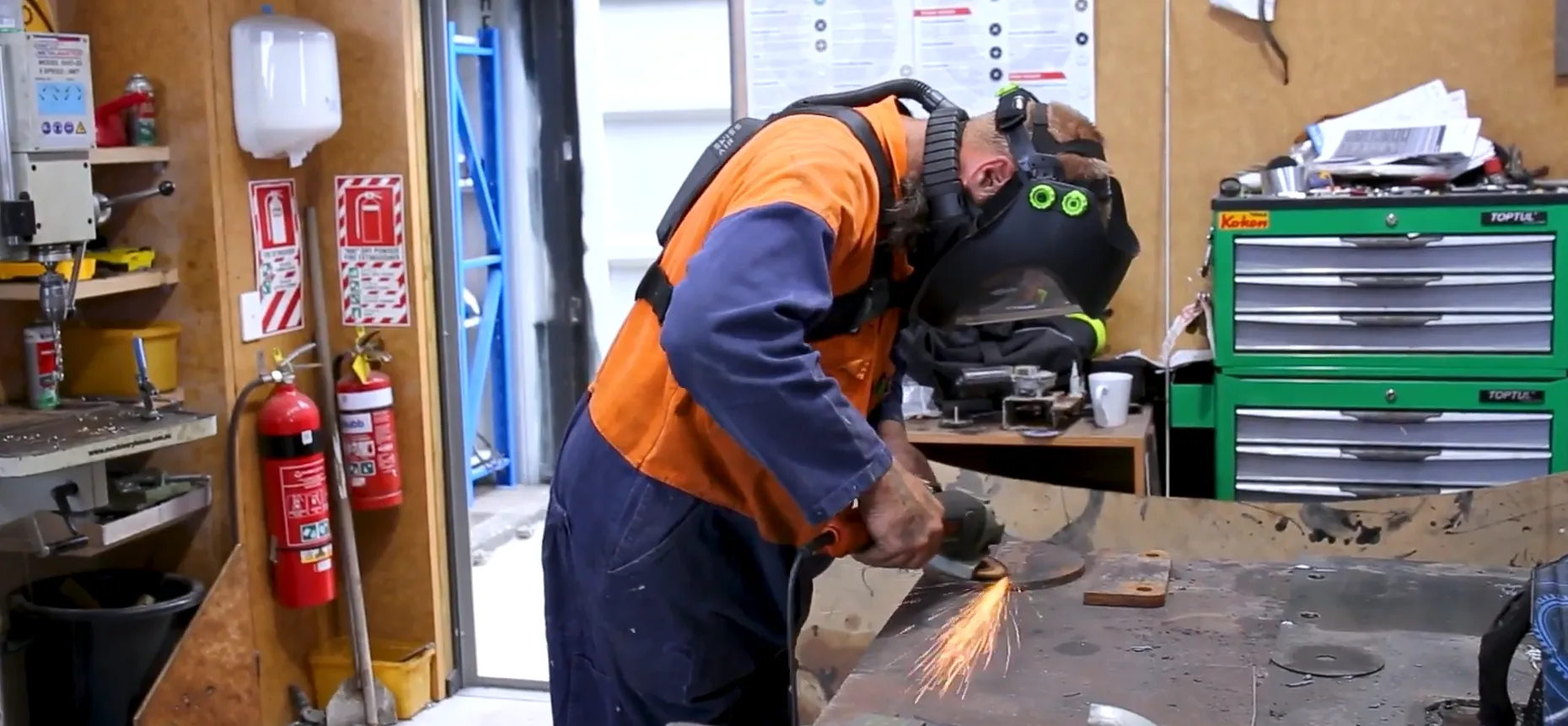
Smith Engineering Tasman uses the Swiss Air with a Clearmaxx grinding helmet in marine engineering work. In his interview, Paul Grayson describes grinding the underside of a rusty boat, where the fumes and dust are heavy, and space is tight. Compared with his earlier Speedglas setup, he found the Swiss Air lighter at about 1.2 kg, sealed better around his beard, and less prone to fogging. He calls it a "super light system". Read the interview write-up.
In the R E M Ltd review, Sam and Blair talk about how the Swiss Air has changed their working environment and how it compares with other options on the market.
Who the Swiss Air is not for
Do not use it where the contaminant is a gas or vapour, such as solvent or paint spraying. Do not use it where the hazard is unknown, oxygen is low, the atmosphere is flammable or explosive, or the temperature is outside the range of -5 to 55 degrees Celsius. Strong wind can reduce protection, and it does not protect skin or hearing.
It also does not replace fume control. WorkSafe NZ points out that local exhaust ventilation protects everyone nearby, whereas RPE protects only the wearer and should not be the first or only control. See WorkSafe's welding health and safety guidance and our post on which respirator suits your workshop.
Watch the Swiss Air videos
- Optrel Swiss Air and Clearmaxx Grinding Helmet Combo | Smith Engineering Tasman | New Zealand PAPR: Paul explains how the Swiss Air and Clearmaxx grinding helmet perform in a marine engineering workshop.
2. Optrel Swiss Air PAPR | Unboxing | Proline Industrial: Patrick goes through each item in a complete system.
3. R E M Ltd - Swiss Air Review with Proline Industrial: Sam and Blair describe how the Swiss Air has changed their work environment and how it compares with other options.
More videos are on the Proline Industrial YouTube channel.